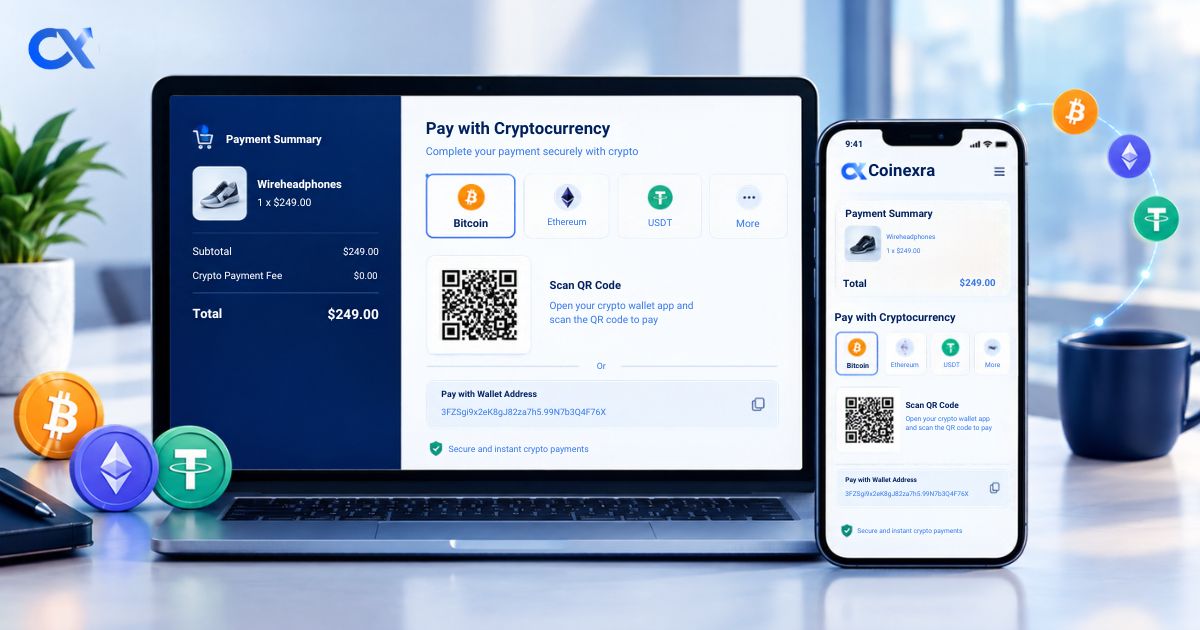

The crypto industry is moving beyond trading and investment toward everyday digital payments. Crypto cards are becoming an important bridge between digital assets and traditional payment systems, allowing users to spend cryptocurrencies for online purchases, in-store transactions, and other everyday expenses.
For entrepreneurs, this creates an opportunity to build a crypto card business in 2026 by combining cryptocurrency wallets, card issuing infrastructure, payment processing, and compliance systems into one platform.
But launching a crypto card business involves much more than developing a mobile app. Businesses need to select the right operating model, establish partnerships with card networks and financial institutions, implement compliance controls, integrate blockchain infrastructure, and build a secure crypto card platform.
This guide explains how to start a crypto card business in 2026, including business models, essential features, technology, compliance considerations, development costs, and monetization strategies.
What Is a Crypto Card Business?
A crypto card business provides customers with cards that allow them to spend digital assets through conventional payment networks.
Depending on the platform architecture, users may be able to:
- Spend cryptocurrencies at merchants
- Convert crypto into fiat during transactions
- Hold multiple cryptocurrencies
- Buy and sell digital assets
- Make online and offline payments
- Withdraw funds through ATMs
- Track transactions through a mobile application
- Earn cashback or rewards
- Manage card limits and security settings
A crypto card platform typically connects crypto wallets, blockchain networks, payment processors, card issuing partners, and banking infrastructure to create a seamless spending experience.
Why Start a Crypto Card Business in 2026?
The growing adoption of digital assets is creating demand for practical crypto payment solutions. Users increasingly want to use their cryptocurrency beyond exchanges and investment platforms.
A well-designed crypto card platform can address this demand by providing a familiar card payment experience while maintaining access to digital assets.
Key opportunities include:
Growing Crypto Payment Adoption
Consumers and businesses are increasingly exploring cryptocurrency as a payment and settlement method. Crypto cards make digital assets easier to use in everyday transactions.
Demand for Convenient Crypto Spending
Users do not always want to manually convert cryptocurrency into fiat before making a purchase. Crypto cards can automate conversion at the point of payment, depending on the platform's model and jurisdiction.
Multiple Revenue Opportunities
Crypto card businesses can generate revenue through transaction fees, foreign exchange spreads, card fees, subscriptions, interchange-related arrangements, and other services.
Global Market Potential
With appropriate licensing, partnerships, and regional compliance, crypto card platforms can potentially serve users across multiple markets.
How to Start a Crypto Card Business?
Launching a crypto card business requires a structured approach that combines card issuing, crypto and fiat infrastructure, payment processing, regulatory compliance, security, and platform development. From choosing your business model and target market to integrating blockchain networks and launching virtual or physical cards, each stage plays an important role in building a scalable crypto card platform.
Here are the major steps to start a crypto card business:
1. Define your crypto card business model
2. Select your target market
3. Choose the right card issuing model
4. Establish crypto and fiat infrastructure
5. Develop the crypto card platform
6. Integrate supported blockchain networks
7. Implement KYC and AML compliance
8. Build strong security infrastructure
9. Launch virtual cards before physical cards
10. Finalize your crypto card revenue model
1. Define Your Crypto Card Business Model
Start by determining how your platform will operate and generate revenue.
Define the crypto card business model before choosing technology or partners: decide whether users will pre-fund a fiat balance, spend crypto through real-time conversion at checkout, or use a collateral-backed credit structure. Also define whether the offering is prepaid, debit, virtual-only, physical, or a combined crypto card program, because each model changes the user journey, liquidity requirements, risk controls, and regulatory responsibilities.
Common models include:
Crypto-to-Fiat Cards: Users hold crypto and convert it into fiat when making payments.
Prepaid Crypto Cards: Users load funds onto a card and spend within predefined limits.
Debit Crypto Cards: Cards are connected to a crypto or fiat account and can be used for everyday transactions.
Virtual Crypto Cards: Users receive digital cards primarily for online transactions.
Physical Crypto Cards: Users receive physical cards that can be used at supported merchants and ATMs.
You can also combine virtual and physical cards to serve different customer needs.
2. Select Your Target Market
The regulatory and payment environment varies significantly between countries. Therefore, choosing your target market is one of the most important decisions.
Select your target market before building the product because card availability depends on more than crypto demand. It relies on local licensing, issuer and banking-partner coverage, card-network rules, KYC/AML obligations, consumer-protection requirements, tax treatment, and the ability to settle in the relevant fiat currency.
Evaluate:
- Cryptocurrency adoption
- Payment infrastructure
- Card usage
- Licensing requirements
- AML and KYC obligations
- Tax requirements
- Banking partnerships
- Card issuing availability
- Local consumer protection regulations
A crypto card that works in one country cannot simply be offered elsewhere without validating the local operating model.
3. Choose the Right Card Issuing Model
A crypto card company generally needs access to card issuing infrastructure and payment networks.
Before selecting an issuer, processor, or program manager, clearly define ownership of KYC/AML, fraud controls, transaction authorization, settlement, chargebacks, cardholder support, ledger reconciliation, and compliance reporting.
You can build partnerships with:
- Card issuing processors
- Banking-as-a-service providers
- Payment institutions
- Electronic money institutions
- Card program managers
- Payment gateways
- Cryptocurrency liquidity providers
Depending on your jurisdiction and business model, you may operate through licensed partners or obtain the necessary licenses yourself.
For startups, partnering with established infrastructure providers can significantly reduce the complexity of launching the initial product.
4. Establish Crypto and Fiat Infrastructure
A crypto card platform needs reliable infrastructure to manage digital assets, fiat transactions, and the movement of funds between them. This infrastructure connects user wallets, custody or self-custody flows, on-chain deposits and withdrawals, liquidity providers, crypto-to-fiat conversion, internal ledgers, and regulated fiat accounts.
The core infrastructure may include:
- Multi-currency and multi-chain wallets
- Custodial or non-custodial wallet infrastructure
- Blockchain connectivity
- Crypto deposit and withdrawal processing
- Crypto-to-fiat conversion
- Liquidity provider integration
- Fiat accounts and banking integrations
- Internal ledger and balance management
- Payment processing infrastructure
- Transaction monitoring and reconciliation
- Settlement infrastructure
A well-designed infrastructure ensures that crypto balances can be securely converted and settled into fiat when users make card payments, while maintaining accurate balances, transaction records, and regulatory controls.
5. Develop the Crypto Card Platform
Once the business model, card issuing strategy, and underlying infrastructure are defined, crypto card platform development can begin.
A robust crypto card platform needs more than a customer-facing app. It should include an operational layer for KYC/KYB reviews, AML and fraud monitoring, card lifecycle management, exception handling, fee configuration, reporting, customer support workflows, reconciliation, and audit logs.
Build and test integrations in a sandbox environment where available, validate critical transaction and card flows, and run controlled pilots before expanding to broader cardholder segments or physical card fulfillment.
A comprehensive crypto card platform typically includes:
Customer Mobile App
The customer application should allow users to:
- Register and complete identity verification
- Create and manage crypto wallets
- Order virtual or physical cards
- Activate cards
- View crypto and fiat balances
- Make card payments
- View transaction history
- Freeze or unfreeze cards
- Manage spending limits
- Deposit and withdraw funds
- Convert supported crypto assets to fiat
- Manage card and account security settings
Web-Based Admin Panel
Administrators need centralized tools to manage users, cards, transactions, compliance, and platform operations.
Important capabilities include:
- User and account management
- KYC/KYB verification management
- Card lifecycle management
- Transaction monitoring
- Payment management
- Wallet management
- Asset management
- Fee and pricing configuration
- Spending and transaction limit management
- Fraud monitoring
- Reconciliation and settlement tracking
- Reports and analytics
- Customer support management
- Audit logs
Card Management Infrastructure
The card management layer should support the complete card lifecycle, including:
- Virtual card issuance
- Physical card issuance
- Card activation
- PIN management
- Card blocking and unblocking
- Spending limits
- Merchant category controls
- Transaction authorization
- Card replacement and renewal
- Card status management
- Physical card fulfillment integration
The platform should also be designed to integrate with the selected card issuer, payment processor, banking partners, liquidity providers, blockchain networks, and compliance providers. This integrated architecture helps ensure that card transactions, crypto conversions, balances, and settlements work together reliably as the business scales.
6. Integrate Supported Blockchain Networks
Supporting multiple blockchain networks allows a crypto card platform to support the digital assets and wallets most relevant to its target users, including Bitcoin, Ethereum, Solana, BNB Chain, Polygon, and stablecoin networks. However, businesses should prioritize networks based on customer demand, liquidity availability, transaction costs, settlement requirements, and compatibility with their custody, conversion, payment, and card-issuing partners. Starting with the most relevant networks can simplify infrastructure management while allowing the platform to expand as user demand grows.
Potential networks include:
- Bitcoin
- Ethereum
- BNB Chain
- Solana
- Polygon
- Avalanche
- Other compatible networks
A modular multi-chain wallet architecture with isolated chain adapters, unified balance and ledger controls, real-time reconciliation, and chain-specific KYT screening is far safer than adding networks through disconnected
7. Implement KYC and AML Compliance
Compliance should be built into the crypto card platform from the beginning. Depending on the jurisdiction and business model, the platform may need KYC/KYB verification, AML monitoring, sanctions screening, risk assessment, and ongoing transaction monitoring.
For virtual-asset transfers, Travel Rule capabilities may also be required to securely collect and transmit relevant originator and beneficiary information between applicable service providers.
Key compliance requirements may include:
- KYC/KYB verification
- Customer due diligence
- AML transaction monitoring
- Sanctions screening
- Risk scoring
- Suspicious activity monitoring
- Travel Rule compliance
- Transaction limits
- Record keeping
- Regulatory reporting
Requirements vary by jurisdiction, custody model, asset flows, and partner structure. Consult qualified local legal and compliance advisers before launching.
8. Build Strong Security Infrastructure
A secure crypto card platform should protect wallets, payment data, personal information, and administrative systems through encryption, strong authentication, access controls, secure key management, API protection, and continuous security testing.
Important security measures can include:
- Multi-factor authentication
- Encryption in transit and at rest
- Secure key management
- Role-based access control
- Transaction monitoring
- Device fingerprinting
- Fraud detection
- Rate limiting
- Session management
- API security
- Secure wallet infrastructure
- Audit logs
- Real-time security alerts
For systems within PCI DSS scope, implement appropriate access controls and authentication for the cardholder data environment. Use tokenization and minimize the storage of sensitive card data wherever possible.
9. Launch Virtual Cards Before Physical Cards
Launching virtual crypto cards first can be a practical way to validate demand, test wallet-to-card payment flows, and refine KYC, AML, crypto-to-fiat conversion, and fraud controls before investing in physical-card production and fulfillment. Virtual cards can often be issued through card APIs without the manufacturing, inventory, shipping, and replacement costs associated with physical cards.
Virtual cards can help businesses:
- Reduce initial operational complexity
- Test customer demand
- Validate payment and transaction flows
- Gather user feedback
- Optimize the product
- Expand to physical cards later
Once the platform demonstrates sufficient demand and operational readiness, physical crypto cards can be introduced through suitable issuing and fulfillment partners.
10. Finalize Your Crypto Card Revenue Model
A crypto card business can combine multiple revenue streams based on its card program, target market, pricing strategy, and partner agreements.
Transaction Fees
Charge fees on eligible card transactions or specific platform services.
Card Issuance Fees
Charge users for physical card issuance, replacement cards, or premium card tiers.
Monthly or Annual Subscription
Offer paid plans with higher limits, additional features, rewards, or premium services.
Foreign Exchange Fees
Generate revenue from supported currency conversion services where legally and contractually permitted.
ATM Fees
Charge applicable fees for cash withdrawals through supported ATMs.
Crypto Conversion Fees
Apply a fee or spread when users convert supported cryptocurrencies into fiat for card spending.
Premium Card Programs
Offer premium cards with benefits such as higher spending limits, rewards, enhanced support, or additional services.
Partner Revenue
Generate additional revenue through partnerships with merchants, financial service providers, and other ecosystem participants.
Essential Features of a Crypto Card Platform
A competitive crypto card platform should combine payment functionality with crypto management capabilities.
| Feature | Purpose |
| Multi-Asset Wallet | Manage multiple digital assets |
| Virtual Cards | Enable instant online payments |
| Physical Cards | Support offline and in-store payments |
| Crypto-to-Fiat Conversion | Convert assets for eligible transactions |
| Real-Time Transaction Tracking | Monitor payments instantly |
| Card Controls | Freeze, unblock, and manage cards |
| Spending Limits | Control transaction and withdrawal limits |
| KYC Integration | Verify customer identities |
| AML Monitoring | Detect potentially suspicious activity |
| Push Notifications | Alert users about transactions |
| Multi-Currency Support | Support different fiat and crypto assets |
| Admin Dashboard | Manage users, cards, transactions, and settings |
| Analytics | Track business and transaction performance |
Technology Stack for Crypto Card Development
The technology stack depends on the platform's requirements, scalability, security model, and integrations.
A typical architecture may include:
Frontend: React.js, Next.js, React Native, Flutter
Backend: Java, Node.js, Go, Python, or similar technologies
Database: PostgreSQL, MongoDB, Redis
Blockchain: Ethereum, Bitcoin, Solana, BNB Chain, Polygon, and other required networks
APIs: REST APIs and WebSocket APIs
Cloud: AWS, Google Cloud, Microsoft Azure, or comparable infrastructure
Security: Encryption, MFA, HSM or secure key management, API security, fraud monitoring
The final architecture should be designed around the card issuer, payment processor, blockchain infrastructure, compliance requirements, and expected transaction volume.
Crypto Card Business Architecture
A typical crypto card business architecture consists of several interconnected layers that work together to manage users, digital assets, card transactions, and fiat settlement:
User Layer → Mobile/Web Application → Backend Services → Wallet & Blockchain Infrastructure → Crypto-Fiat Conversion & Liquidity → Card Issuer/Processor → Card Network → Merchant
The backend serves as the central orchestration layer, connecting customer accounts, wallets, payment transactions, compliance systems, blockchain infrastructure, and external financial service providers.
A scalable crypto card architecture should also include monitoring, logging, fraud prevention, analytics, reconciliation, security controls, and disaster recovery mechanisms to support reliable operations as the platform grows.
How Much Does It Cost to Start a Crypto Card Business?
The cost to start a crypto card business typically ranges from $50,000 to $250,000+, depending heavily on the business model, geographic market, licensing requirements, integrations, card program, supported assets, and level of customization.
A basic platform with virtual cards and limited integrations may require around $50,000–$100,000, while a fully customized global crypto card ecosystem supporting physical cards, multiple blockchain networks, advanced compliance, and extensive financial integrations can require $150,000–$250,000+.
Major cost factors include:
Product design and development: $15,000–$50,000+
Mobile application development: $10,000–$30,000+
Backend infrastructure: $15,000–$40,000+
Card issuing integration: $5,000–$20,000+
Payment processor integration: $5,000–$20,000+
Blockchain integration: $5,000–$25,000+
KYC and AML providers: $2,000–$10,000+ initially, plus usage fees
Security infrastructure: $5,000–$25,000+
Cloud hosting: $500–$5,000+/month
Licensing and legal expenses: $10,000–$100,000+, depending on jurisdiction and licensing model
Liquidity and settlement infrastructure: $5,000–$30,000+
Physical card production and fulfillment: Variable based on volume and provider
Maintenance and support: 15%–25% of initial development cost annually
These figures are indicative rather than fixed quotes. Actual costs can vary significantly based on the country, licensing structure, card issuer, payment network, technology stack, number of supported assets, and third-party providers.
Instead of focusing only on development costs, entrepreneurs should calculate the total operational cost of running the card program, including licensing, compliance, processing, liquidity, card issuance, infrastructure, security, and ongoing support.
How Long Does It Take to Build a Crypto Card Platform?
Development time depends on the scope, number of integrations, target market, card program, and level of customization. A basic crypto card MVP may take around 8–12 weeks when using existing card issuing, payment, compliance, and blockchain infrastructure. A more customized platform with multiple integrations, physical cards, advanced transaction processing, and extensive compliance capabilities may take 4–8 months or longer.
A typical development roadmap includes:
Business and compliance analysis: 1–3 weeks
UI/UX design: 2–4 weeks
Architecture planning: 1–2 weeks
Backend development: 4–8 weeks
Mobile/web development: 4–8 weeks
Blockchain integration: 2–5 weeks
Card issuer integration: 2–6 weeks
KYC/AML integration: 1–3 weeks
Security testing: 2–4 weeks
Payment testing: 1–3 weeks
Deployment: 1–2 weeks
Post-launch optimization: Ongoing
Many of these activities can run in parallel, so the individual durations should not be added together to determine the total project timeline. Actual delivery time also depends on third-party approvals, issuer onboarding, compliance reviews, licensing, and certification requirements.
How Coinexra Can Help You Launch a Crypto Card Business
Launching a crypto card business requires more than a card application. You need a technology ecosystem that connects digital assets, wallets, payment processing, card infrastructure, compliance, and user management.
Coinexra provides white-label crypto card solutions designed to help businesses enter the crypto payment market with a ready-to-customize platform.
The platform can be tailored around your branding, supported assets, blockchain networks, card requirements, transaction flows, and target market.
With a white-label approach, businesses can focus on customer acquisition and market expansion while leveraging established crypto card technology instead of developing every component from scratch.
Ready to launch your crypto card business? Talk to our experts now and build a branded crypto payment platform for your target market.