
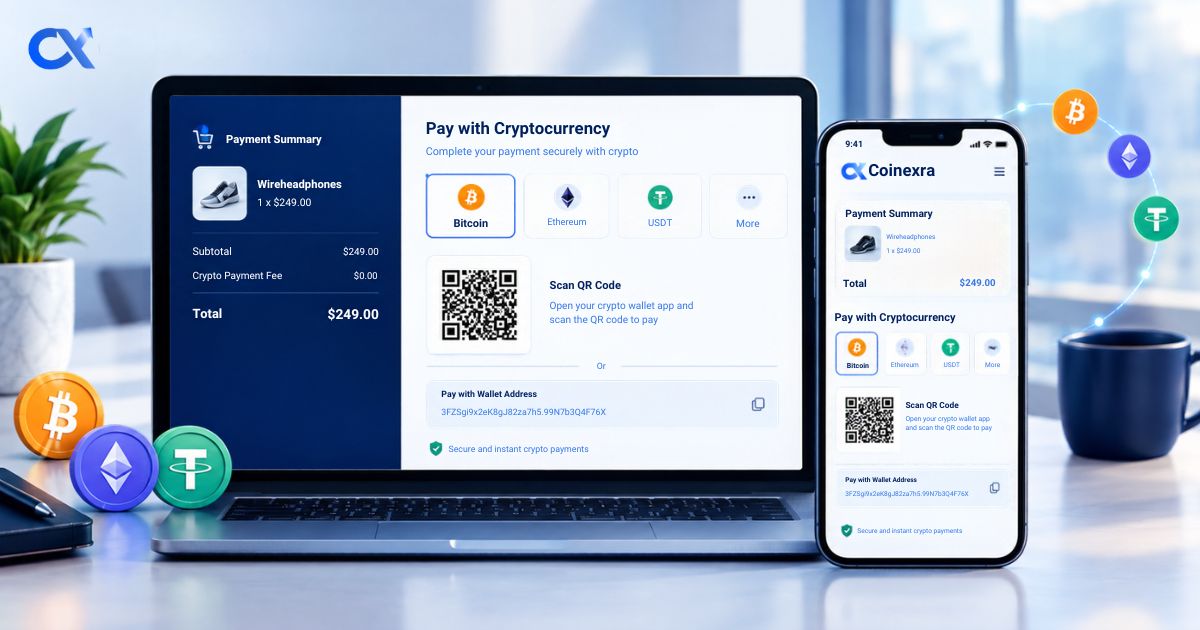
Accepting cryptocurrency on a website is no longer limited to displaying a wallet address and asking customers to send funds manually. A modern crypto payment integration can automate payment requests and support crypto or fiat settlement.
This guide explains how to integrate a crypto payment gateway on a website, how each integration method works, what to consider before going live, and when a white-label solution may make more sense than relying entirely on a third-party processor.
What Is a Crypto Payment Gateway for a Website?
A crypto payment gateway is a payment infrastructure layer that allows a website or online business to accept cryptocurrency from customers and manage the payment process electronically.
Instead of manually checking wallet addresses and blockchain transactions, the gateway can automate important parts of the payment lifecycle.
A typical crypto payment gateway can handle:
- Payment request creation
- Cryptocurrency and network selection
- Payment address or QR code generation
- Crypto-to-fiat price calculation
- Transaction monitoring
- Blockchain confirmation
- Payment-status updates
- Webhook notifications
- Settlement
- Transaction records and reconciliation
How Does a Crypto Payment Gateway Work?
A crypto payment gateway acts as the connection between a website, the customer, & the underlying blockchain payment infrastructure. Instead of requiring merchants to manually monitor wallet addresses and blockchain transactions, the gateway coordinates the payment process from checkout through confirmation and settlement.
The process typically moves through the following stages:
1. A customer places an order on a website.
2. The website creates a crypto payment request.
3. The gateway calculates the required cryptocurrency amount.
4. The customer receives a wallet address, QR code, or hosted checkout.
5. The customer sends the cryptocurrency.
6. The gateway monitors the blockchain transaction.
7. The required payment confirmation is detected.
8. The gateway sends the payment status to the merchant's website.
9. The website updates the order.
10. Funds are settled according to the merchant's configuration.
This automated flow allows cryptocurrency payments to become part of the website's existing checkout and order-management process rather than requiring manual transaction verification for every purchase.
How to Integrate a Crypto Payment Gateway on a Website
The exact implementation depends on the gateway and website technology, but the overall process generally follows eight stages.
Step 1: Define Your Payment Requirements
Before integrating any crypto payment gateway, determine exactly what your business needs. Start with:
- Which cryptocurrencies you want to accept
- Which blockchain networks you need
- Whether stablecoins are required
- Whether customers should pay in crypto only or crypto and fiat
- Whether you need crypto-to-fiat conversion
- Whether you need invoices or payment links
- Whether you need a hosted or fully customized checkout
- Whether your business requires a branded payment experience
Also consider your expected transaction volume. Defining these requirements first prevents you from choosing a gateway that cannot support your future workflow.
Step 2: Choose a Crypto Payment Gateway
Once the requirements are clear, evaluate potential gateway providers against the features your website actually needs. Important evaluation criteria include:
- Supported cryptocurrencies
- Supported blockchain networks
- API availability
- Webhook support
- Checkout customization
- Settlement options
- Security controls
- Scalability
Don't evaluate a gateway solely by the number of cryptocurrencies it supports.
Step 3: Select the Integration Method
The right integration method depends largely on your website and the level of control you require. Common approaches include:
- Hosted checkout
- Payment links
- Payment buttons
- E-commerce plugins
- API integration
- White-label payment infrastructure
A hosted checkout can be appropriate when speed and simplicity are the priority. An API integration is generally more suitable when you need control over the checkout experience.
And a white-label solution is a different model altogether. It can be used when a business wants to operate a branded crypto payment infrastructure rather than simply redirecting customers to another provider's payment experience.
Step 4: Configure Your Payment Checkout
The checkout is the part of the payment experience customers interact with. Depending on the integration, it may display:
- Order amount
- Selected cryptocurrency
- Crypto amount to pay
- Wallet address
- QR code
- Payment status
The checkout should make the payment instructions unambiguous. For example, if the customer is paying USDT, the checkout should clearly identify the supported network.
Step 5: Connect the API or Plugin
Connect the selected crypto payment gateway to your website using its available API, plugin, or extension. The integration provides the essential tools needed to configure and manage crypto payments within your existing website. Key integration requirements include:
- API Access
- Plugin or Extension Support
- Payment Configuration
- Webhook Support
- Authentication & Security
- Integration Documentation
Step 6: Configure Webhooks and Payment Status
Configure webhooks so your website can receive secure payment-status updates from the crypto payment gateway. Proper webhook configuration helps keep payment records and order statuses synchronized with the gateway. Key configurations include:
- Webhook URL
- Payment Status Events
- Webhook Authentication
- Signature Verification
- Event Handling
- Retry & Error Handling
Step 7: Test the Integration
Never move directly from development to production without testing the complete payment lifecycle. Test scenarios should include:
- Successful payment
- Failed payment
- Expired payment
- Incorrect payment amount
- Delayed blockchain confirmation
- Duplicate webhook
The objective is not simply to prove that a successful payment works. A reliable integration must also behave correctly when something goes wrong.
Step 8: Launch and Monitor Payments
After testing, activate the integration in the production environment. Continue monitoring the platform payments:
- Successful payments
- Failed payments
- Pending transactions
- Blockchain confirmations
- Webhook delivery
- Settlement
Set up appropriate alerts so operational issues can be identified before they affect a large number of customers.
Choose the Right Crypto Payment Gateway Integration Method
The right crypto payment gateway integration method depends on your website type, desired customization, and how quickly you want to launch. Choosing the appropriate approach can simplify integration while giving your business the flexibility needed to manage crypto payments.
| Integration Method | Best For | Technical Effort | Customization | Typical Experience |
| Hosted Checkout | Fast deployment | Low | Medium | Redirect/hosted checkout |
| Payment Link | Simple payments | Very Low | Low | Link-based payment |
| Plugin/Extension | Shopify/WooCommerce style stores | Low | Medium | Native store checkout |
| API Integration | Custom websites/apps | Medium–High | High | Custom checkout |
| White Label Gateway | Businesses launching branded payment infrastructure | High initially | Very High | Fully branded |
Of these models, a white-label crypto payment gateway is especially relevant for businesses planning to build a branded crypto payment business rather than simply using another provider's checkout.
How to Add Crypto Payments to Your Website
Businesses have several ways to add cryptocurrency payments to a website. The appropriate option depends on technical requirements, customization, payment volume, & business model.
Option 1: Add a Hosted Crypto Checkout
A hosted crypto checkout lets businesses accept cryptocurrency through a payment page provided by the gateway. It is a practical option for businesses that want to add crypto payments without building a fully customized checkout interface. Key considerations:
- Quick deployment
- Minimal development work
- Gateway-managed checkout
- Support for multiple cryptocurrencies
- Payment status tracking
- Suitable for simple payment requirements
Option 2: Add a Crypto Payment Button or Payment Link
A crypto payment button or payment link provides a simple way to direct customers to a crypto payment experience. This approach works particularly well for businesses selling individual products, digital services, invoices, or accepting direct payments. Key considerations:
- Easy to add to existing pages
- Minimal technical requirements
- Suitable for individual payment requests
- Customizable payment amount
- Shareable payment links
- Suitable for simple checkout experiences
Option 3: Integrate Through a Plugin
A plugin can connect a crypto payment gateway with supported e-commerce platforms. This can reduce development effort while allowing crypto payments to become part of an existing online store. Key considerations:
- Platform compatibility
- Simple installation
- Easier configuration
- Checkout integration
- Order management compatibility
- Gateway update support
Option 4: Integrate Through a Payment Gateway API
API integration provides greater control over how crypto payments are incorporated into a website or application. It is generally suited to businesses that need a customized payment experience and deeper integration with their existing systems. Key considerations:
- Custom checkout experience
- Direct API connectivity
- Webhook integration
- Payment status management
- Custom business logic
- Greater scalability and flexibility
How to Integrate a Crypto Payment Gateway With an E-Commerce Website
E-commerce integration requires more than simply receiving cryptocurrency. The payment needs to connect correctly with the existing order lifecycle. The integration method varies depending on the e-commerce technology being used.
Shopify / E-Commerce Platforms
For supported e-commerce platforms, businesses may use an available payment application, extension, or provider integration. The key considerations include:
- Compatibility with the platform
- Checkout customization
- Supported cryptocurrencies
- Order-status synchronization
- Settlement
- API/Webhook support
Before selecting an integration, confirm that the payment workflow fits the platform's checkout and order-management architecture.
WooCommerce
WooCommerce websites can integrate crypto payments through compatible payment extensions. A typical workflow is:
1. Install and configure the payment integration.
2. Add merchant/API credentials.
3. Select supported cryptocurrencies.
4. Configure checkout settings.
5. Map gateway statuses to WooCommerce order statuses.
6. Test successful and failed payments.
7. Activate the payment method.
Businesses with more customized WooCommerce workflows may require additional backend development.
Custom-Built Website
A custom website provides the greatest flexibility because the payment gateway can be integrated directly into the existing backend. This approach can support:
- Custom checkout experiences
- Multiple payment methods
- Custom payment statuses
- Automated order fulfillment
- Custom settlement logic
- Merchant dashboards
For custom websites, API and webhook integration are particularly important because the payment gateway needs to communicate reliably with the website's backend.
How to Secure a Crypto Payment Gateway Integration
Security should be built into the crypto payment gateway integration from the beginning, rather than added after deployment. A secure implementation also helps ensure that payment confirmations and order updates are processed reliably.
Use HTTPs/TLS
Use HTTPS/TLS encryption to protect data exchanged between the customer's browser & payment infrastructure. This helps prevent unauthorized interception of sensitive payment information.
Verify Webhook Signatures
Verify webhook signatures before accepting payment notifications from the gateway. This helps ensure that incoming events are authentic and have not been modified or spoofed.
Validate Payment Status Server-side
Payment status should be verified on the server rather than relying only on information displayed in the customer's browser. This reduces the risk of unauthorized payment confirmations being used to trigger order fulfillment.
Implement Idempotency
Use idempotency controls to prevent the same payment event from being processed multiple times. This is particularly important when gateways retry webhook notifications.
Validate Payment Amount and Currency
Confirm that the received payment matches the expected amount and cryptocurrency for the order. This helps identify incorrect, incomplete, or unexpected payments before fulfillment.
Prevent Duplicate Order Fulfillment
Ensure that a confirmed transaction cannot trigger the same order fulfillment more than once. Payment and order systems should maintain a reliable record of processed transactions.
Maintain Audit Logs
Maintain records of payment events, webhook activity, status changes, and settlement-related actions. These logs help with troubleshooting, security monitoring, and maintaining a clear transaction history.
White Label Crypto Payment Gateway vs Third-Party Crypto Payment Processor
A third-party processor is generally used when a business wants to accept cryptocurrency payments through an existing provider. A white-label gateway is more relevant when a business wants to operate a branded payment infrastructure or payment offering under its own identity.
| Factor | Third-Party Processor | White Label Gateway |
| Branding | Provider branding may appear | Your brand |
| Customer experience | Provider-controlled | Customizable |
| API access | Depends on provider | Core infrastructure access |
| Merchant dashboard | Provider | Your branded environment |
| Business model | Accept payments | Build/operate branded payment infrastructure |
| Customization | Limited–Moderate | High |
| Control | Provider-dependent | Greater control |
| Scalability | Provider-dependent | Configurable |
Why Choose Coinexra for Crypto Payment Gateway Infrastructure?
Coinexra provides white-label crypto payment gateway infrastructure for businesses that want to build a branded crypto payment experience rather than simply redirect customers to a third-party payment page.
Multi-Currency & Multi-Chain Infrastructure
Support payments across multiple cryptocurrencies and blockchain networks through a unified payment infrastructure. This gives businesses flexibility to serve customers with different digital asset preferences.
Merchant Management
Manage merchants, payment activity, and relevant transaction information through a centralized infrastructure. The setup can support businesses operating a branded payment solution for multiple merchants.
Settlement Infrastructure
Configure settlement options according to the business's operational and payment requirements. The infrastructure can support different settlement models across supported digital assets and payment flows.
API & Integration Support
Connect crypto payment functionality with websites, applications, and existing business systems through API-based integration. This provides greater flexibility for businesses requiring customized payment experiences.
Security & Compliance-Ready Infrastructure
Build the payment environment with security controls and infrastructure designed to support compliance requirements. This provides a stronger foundation for businesses handling cryptocurrency payments at scale.
Scalable Architecture
Use infrastructure designed to support growing transaction volumes and expanding payment requirements. Businesses can scale their crypto payment operations without having to rebuild the underlying payment infrastructure.
FAQs
How do I integrate a crypto payment gateway on a website?
To integrate a crypto payment gateway on a website, first define your payment requirements and choose a suitable gateway. For an API integration, the typical process is:
- Create merchant/API credentials.
- Connect the website backend to the gateway API.
- Create payment requests.
- Display the payment instructions to customers.
- Configure webhooks.
- Verify payment status server-side.
- Update orders after confirmed payments.
- Test the complete workflow before going live.
Can I integrate a crypto payment gateway without building one from scratch?
Yes. Businesses can integrate an existing crypto payment gateway through hosted checkout, payment links, plugins, or APIs. If the objective is to launch a branded crypto payment infrastructure without developing every payment component internally, a white-label crypto payment gateway can provide another implementation model.
Can I integrate a crypto payment gateway with WooCommerce?
Yes, depending on the gateway and its available integration options. WooCommerce stores can use compatible payment plugins or API-based integrations. Before implementation, verify support for the required cryptocurrencies, networks, payment statuses, webhooks, and settlement options.
Can I integrate crypto payments into a custom website?
Yes. A custom website can integrate crypto payments through a payment gateway API. An API-based implementation can connect the payment gateway with your website's checkout, order management, payment status, settlement workflows, and more. This approach provides greater control over the payment experience than a basic payment link.
Is a crypto payment gateway secure?
A crypto payment gateway can be secured through multiple layers, including encrypted communication, secure API credential management, webhook verification, server-side payment validation, access controls, transaction monitoring, and audit logging.
How much does crypto payment gateway integration cost?
A white-label crypto payment gateway can typically cost around 10,000-50,000+, depending on branding, API integration, supported cryptocurrencies and networks, customization, settlement requirements, security, and scalability.