
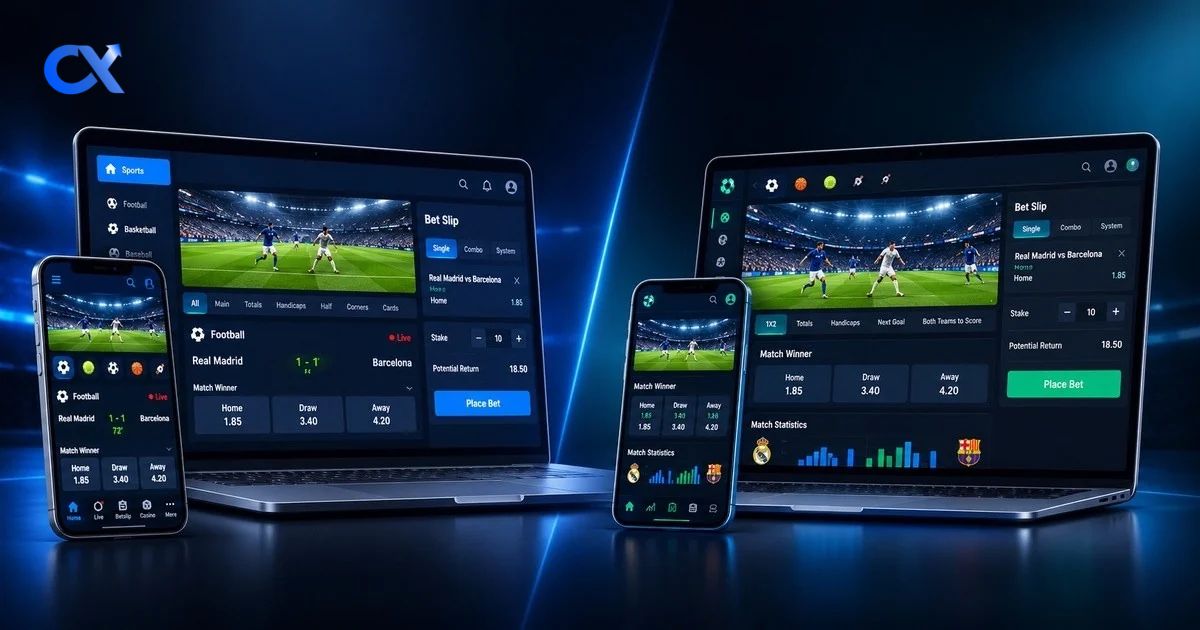
Launching a sportsbook involves much more than creating a betting interface. The development model you choose affects your launch timeline, technology ownership, customization, infrastructure, operating costs, scalability, and long-term control.
A business can build its sportsbook from the ground up through custom development or use established white-label sportsbook software and customize it around its brand and operating requirements.
In this guide, we will break down the differences between custom and white-label sportsbook models across the factors that matter before and after launch.
Custom vs. White Label Sportsbook: At a Glance
Take a look at the comparison below, which highlights the key differences to help you identify which sportsbook development approach best fits your business goals.
| Factor | Custom Sportsbook | White Label Sportsbook |
| Development approach | Built specifically around business requirements | Existing sportsbook infrastructure customized for the operator |
| Launch speed | Generally slower | Generally faster |
| Initial development effort | High | Lower |
| Customization | Very high | High, depending on provider |
| Technology ownership | Greater potential ownership | Core technology usually remains provider-owned |
| Betting infrastructure | Developed and integrated separately | Existing infrastructure |
| Integrations | Selected and developed individually | Existing + additional integrations |
| Technical team | Larger requirement | Lower technical burden |
| Maintenance | Primarily operator/development-team responsibility | Largely provider-supported |
| Scalability | Controlled by the operator's architecture | Dependent on provider infrastructure and agreement |
| Best suited for | Businesses needing deep technical differentiation | Businesses prioritizing speed, efficiency, and established infrastructure |
How a White Label Sportsbook Software Works
A white-label sportsbook provides a foundation that an operator can launch as its own branded sportsbook. Instead of developing every component independently, this works with an established platform containing core sportsbook functionality.
Sportsbook Core
Sports data and odds form the foundation of the sportsbook’s betting environment and market structure. Functions such as:
- Sports and event management
- Betting markets and selections
- Bet placement
- Bet validation
- Settlement workflows
- Player management
- Administrative controls
Odds and Sports Data
Sportsbooks depend on timely data and odds to display available betting opportunities, the infrastructure connects with:
- Sports data providers
- Odds feeds
- Pre-match markets
- Live betting feeds
- Event and market updates
Betting Engine
The betting engine is the core layer that processes wagers and coordinates activity across the sportsbook, including:
- Bet requests
- Validation
- Market availability
- Stake rules
- Acceptance or rejection
- Bet records
- Settlement
Trading and Risk Management
Risk infrastructure helps operators monitor and control exposure across betting activity. It supports functions such as:
- Betting limits
- Exposure monitoring
- Market controls
- Risk rules
- Trading configuration
- Suspicious activity monitoring
Wallet and Player Management
Wallet and player management connect betting activity with each player’s available funds and balances.
- Player accounts
- Wallet balances
- Deposits
- Withdrawals
- Transaction history
- Player limits
- Account management
Payments
Payment infrastructure connects the sportsbook to the external financial systems used to move funds in and out of the platform. The right setup allows operators to support their intended payment environment without rebuilding financial functionality from scratch.
Admin and Analytics
Admin and analytics provide operators with centralized visibility into daily sportsbook platform operations. Operators visibility into:
- Players
- Bets
- Transactions
- Markets
- Risk
- Reports
- Platform activity
- Business performance
What Can You Customize in White Label Sportsbook Software?
Coinexra’s white-label sportsbook can provide substantial customization while retaining an established technology foundation.
| Customization Area | What Can Be Customized |
| Branding | Logo, colors, typography, visual identity |
| Domain | Branded web presence |
| UI/UX | Customer-facing layouts and experience |
| Sports & Markets | Available betting categories and configurations |
| Payments | Supported payment methods |
| Currencies | Supported currencies where applicable |
| Languages | Localized user experience |
| Promotions | Bonuses, campaigns, and offers |
| Player Management | Account rules and segmentation |
| Integrations | APIs and third-party systems |
| Administration | Settings, roles, permissions, and controls |
Benefits of Choosing White Label Sportsbook Software
White-label sportsbook software can reduce the amount of technology an operator needs to build and maintain internally.
Faster Market Entry
An operator can start with established sportsbook infrastructure instead of waiting for every core component to be developed from scratch.
Lower Development Burden
A ready-made platform reduces the amount of core technology an operator needs to build and manage independently in-house.
Established Technology Foundation
Instead of launching with a completely new technology stack, the operator starts with an existing platform that can be configured and tested before going live.
Reduced Technical Overhead
Much of the underlying maintenance, updates, infrastructure management, and technical support can be handled by the provider, depending on the agreement.
Branded Customer Experience
White label technology allows the operator to build its own recognizable sportsbook identity around the underlying platform experience.
Easier Expansion
Coinexra's flexible white label sportsbook foundation supports growth as the operator’s product and market requirements continue to evolve.
More Resources for Business Growth
Reducing the technology workload allows the business to direct more attention toward its broader commercial and growth priorities.
Custom vs. White Label Sportsbook Software: 10 Factors That Actually Matter
Choosing between custom and white label sportsbook software involves more than comparing development models. The following 10 factors provide a practical framework for evaluating both options and identifying which model better fits the sportsbook’s long-term business.
Development Cost
Development cost is not simply about the price of building the first version of a sportsbook. The more important question is how much capital is required to reach a reliable, scalable, and commercially usable platform.
| Cost Consideration | Custom Sportsbook | White Label Sportsbook |
| Initial development | Higher | Lower |
| Core infrastructure | Built from scratch | Existing infrastructure |
| Third-party integrations | Developed and integrated separately | Provider-supported/integration-ready |
| Maintenance responsibility | Primarily operator | Shared or provider-led, depending on agreement |
| Feature expansion | Additional development investment | Often configuration or provider-supported |
| Time-related costs | Longer development cycle | Faster route to launch |
Time to Market
Time to market can directly affect how quickly a sportsbook begins acquiring users and generating revenue. Building the technology foundation from scratch generally creates a longer path between development and commercial launch.
| Time Consideration | Custom Sportsbook | White Label Sportsbook |
| Development timeline | Longer | Shorter |
| Core platform readiness | Built during development | Already established |
| Testing requirements | Extensive from the ground up | Focused on configuration and integration |
| Launch preparation | More development-dependent | More launch-focused |
| Market entry | Slower | Faster |
| Iteration after launch | Requires development resources | Often easier to configure or extend |
Customization and Product Control
Customization determines how closely the sportsbook can match a business’s product vision and operating model. The important distinction is between configuring an existing platform and controlling its underlying technology architecture.
| Customization Consideration | Custom Sportsbook | White Label Sportsbook |
| UI/UX customization | Extensive | Extensive within platform scope |
| Branding | Full control | Full branding possible |
| Business logic | Full control | Provider-dependent |
| Feature configuration | Built specifically | Configurable options |
| Product roadmap | Operator-driven | Shared/provider-dependent |
| Architecture changes | Full control | Limited to available framework |
Technology Ownership and Source Code
Ownership becomes important when long-term independence is a priority. Beyond branding and customization, operators should understand who controls the codebase, architecture, and underlying technology.
| Ownership Consideration | Custom Sportsbook | White Label Sportsbook |
| Source code | Typically operator-owned | Usually provider-owned |
| Technology control | High | Provider-dependent |
| Architecture access | Full | Limited or controlled |
| Platform modifications | Operator-controlled | Subject to platform capabilities |
| Vendor dependency | Lower | Higher |
| Exit flexibility | Generally greater | Depends on agreement |
Betting Engine, Odds and Trading Infrastructure
The betting engine and trading infrastructure sit at the center of sportsbook operations, making their reliability and flexibility critical. Building these components independently requires significant technical expertise and ongoing optimization.
| Infrastructure Consideration | Custom Sportsbook | White Label Sportsbook |
| Betting engine | Custom-built | Established platform |
| Odds integration | Independently integrated | Provider-supported |
| Market management | Custom implementation | Existing capabilities |
| Trading infrastructure | Built and maintained internally | Provider-supported |
| Risk controls | Custom-developed | Existing/configurable |
| Performance optimization | Operator responsibility | Provider-supported |
Payments, Wallet and Player Management
Financial and player-facing infrastructure has a direct impact on the sportsbook experience. These components also require careful integration with the broader platform and operational workflow.
| Platform Area | Custom Sportsbook | White Label Sportsbook |
| Player accounts | Custom-developed | Existing functionality |
| Wallet infrastructure | Built/integrated separately | Existing or integrated |
| Payment integration | Custom integration effort | Provider-supported |
| Transaction workflows | Custom-built | Established workflows |
| User management | Operator-controlled | Platform-supported |
| Expansion | Additional development | Provider/platform dependent |
Security, Compliance and Responsible Gambling
Security and regulatory requirements cannot be treated as an afterthought when selecting sportsbook technology. The technology model affects how much of the underlying security and compliance infrastructure must be developed and maintained.
| Security Consideration | Custom Sportsbook | White Label Sportsbook |
| Security architecture | Built independently | Provider-supported |
| Security updates | Operator responsibility | Often provider-managed |
| KYC/AML integration | Independently implemented | Integration-ready/provider-supported |
| Responsible gambling tools | Custom implementation | Available platform capabilities |
| Monitoring | Built and maintained | Existing/provider-supported |
| Compliance adaptation | Operator-led | Shared/provider-supported |
Business Model Flexibility
A sportsbook platform should support the commercial model rather than constrain it. This includes the ability to adapt the product as the operator enters new markets, targets different audiences, or introduces new revenue opportunities.
| Business Consideration | Custom Sportsbook | White Label Sportsbook |
| Business model changes | Highly flexible | Platform-dependent |
| New market expansion | Custom development | Provider/platform dependent |
| Product experimentation | High control | Configuration-dependent |
| New integrations | Fully controlled | API/integration dependent |
| User segmentation | Custom-built | Available platform capabilities |
| Revenue model changes | Operator-controlled | Platform capabilities/terms dependent |
Scalability and Performance
A sportsbook must remain responsive as user activity, betting volume, markets, and traffic increase. Scalability therefore needs to be evaluated as an infrastructure capability rather than simply a future feature.
| Scalability Consideration | Custom Sportsbook | White Label Sportsbook |
| Infrastructure scaling | Operator-managed | Provider-supported |
| Traffic handling | Custom architecture | Existing architecture |
| Peak-event readiness | Independently engineered | Platform/provider dependent |
| Performance optimization | Operator responsibility | Provider-supported |
| Capacity expansion | Additional engineering | Infrastructure-dependent |
| Long-term growth | Fully controllable | Dependent on provider capability |
Maintenance and Long-Term Operations
Launching a sportsbook is only the beginning of its technology lifecycle. Updates, infrastructure management, integrations, performance improvements, and issue resolution can create a substantial ongoing workload.
| Operational Consideration | Custom Sportsbook | White Label Sportsbook |
| Platform maintenance | Operator-led | Provider-supported |
| Software updates | Internally managed | Often provider-managed |
| Infrastructure management | Operator responsibility | Provider/shared responsibility |
| Bug resolution | Internal development team | Provider support |
| Technical staffing | Higher requirement | Potentially lower |
| Long-term development | Continuous investment | Provider/platform dependent |
A Practical Decision Matrix for Sportsbook Operators
There is no universal winner in the custom vs. white-label decision. The right model depends on which factors matter most to your business.
| Business Requirement | Custom | White Label |
| Fast launch | ★★ | ★★★★★ |
| Low initial development burden | ★★ | ★★★★★ |
| Maximum customization | ★★★★★ | ★★★★ |
| Technology ownership | ★★★★★ | ★★ |
| Existing infrastructure | ★★ | ★★★★★ |
| Proprietary functionality | ★★★★★ | ★★★ |
| Lower technical overhead | ★★ | ★★★★★ |
| Long-term architecture control | ★★★★★ | ★★★ |
| Provider support | ★★ | ★★★★★ |
| Market experimentation | ★★★ | ★★★★★ |
The goal is not to choose the technology model with the highest overall score. It is to choose the model that best matches your business priorities.
How to Evaluate a White Label Sportsbook Provider
Choosing white-label software is only half the decision. Choosing the right provider can have an equally significant impact on the business.
Sports Coverage
Coinexra approaches sports coverage as a core part of sportsbook infrastructure, helping operators build a broader and more competitive betting offering.
- Pre-match markets
- Supported sports
- Live betting markets
- Market depth
- Event coverage
- Geographic availability
Odds & Data Integrations
We support integration-ready sportsbook infrastructure designed to connect operators with the data and odds ecosystem their business requires.
- Data providers
- Odds sources
- Update frequency
- Live data
- Market availability
- Feed redundancy
- Integration flexibility
Betting Engine
Our sportsbook infrastructure is built around a robust betting engine that supports the operational requirements of modern sportsbook businesses.
- Bet placement
- Validation
- Acceptance
- Limits
- Settlement
- Market management
- Live betting
- Risk controls
Payment Infrastructure
Coinexra provides sportsbook infrastructure that can be connected with suitable payment systems, helping operators build a smoother financial experience.
- Deposit methods
- Withdrawal methods
- Payment gateway integrations
- Fiat support
- Cryptocurrency support where applicable
- Transaction management
- Payment-provider flexibility
KYC/AML Capabilities
Our platform comes with per-build KYC and AML integration requirements within the sportsbook architecture, helping operators establish appropriate user verification workflows.
- Identity verification
- KYC workflows
- AML checks
- Transaction monitoring
- Player verification
- Risk screening
Admin & Reporting
Coinexra provides centralized sportsbook administration capabilities that give operators greater visibility and control over day-to-day platform activity.
- Players
- Bets
- Transactions
- Markets
- Reports
- User permissions
- Operational settings
API & Integration Flexibility
Our integration-ready approach allows sportsbook businesses to connect external technologies and build an ecosystem around their core platform.
Security & Infrastructure
Coinexra treats security and infrastructure as foundational requirements, supporting a sportsbook environment designed for dependable operation.
- Authentication
- Access controls
- Audit logging
- Monitoring
- Backup procedures
- Disaster recovery
- Security testing
Scalability
Coinexra builds sportsbook infrastructure with scalability in mind, allowing operators to accommodate growing users, betting activity, and business demands.
Why Choose Coinexra for White Label Sportsbook Software?
Coinexra provides white-label sportsbook software designed to help businesses launch a branded sportsbook without developing every core component from the ground up.
Fully Branded Sportsbook Experience
A fully branded sportsbook can be configured around the operator’s identity, creating a consistent experience across the platform. Branding, interface elements, and customer-facing touchpoints can align with the business’s positioning.
Integrated Sportsbook Infrastructure
Our platform brings essential infrastructure into a connected environment, reducing the need to assemble multiple core components independently. This creates a more streamlined foundation for launching and operating a sportsbook business.
Third-Party Integration Ready
We offer integration flexibility that allows the sportsbook to connect with relevant external service providers. This supports a more adaptable platform ecosystem without limiting the operator to a single technology layer.
Scalable Architecture
Our infrastructure is designed to support increasing betting activity, users, markets, and operational requirements as the business grows. Scalability provides a stronger technical foundation for expansion across new opportunities.
Faster Path From Concept to Launch
Established sportsbook infrastructure can significantly reduce the technical effort required to move from an initial business concept to a functioning platform. This allows operators to focus earlier on customer acquisition and more.
Ongoing Technical Support
We offer continued technical support, providing an additional layer of assistance as the sportsbook evolves after launch. Platform maintenance and technical guidance can help reduce the operational pressure of managing sportsbook technology independently.
FAQs
Is a white-label sportsbook better than a custom sportsbook?
A white-label sportsbook can be better for businesses that prioritize faster market entry, established infrastructure, and lower technical complexity. Custom development can be better when complete technology control, proprietary functionality, and long-term architecture ownership are more important.
What is the difference between custom and white label sportsbook software?
Custom sportsbook software is developed specifically around an operator's requirements, while white-label sportsbook software uses an established platform that can be branded, configured, and customized.
Is white label sportsbook software cheaper than custom development?
White-label sportsbook software requires less initial development investment because the core infrastructure already exists. However, the overall cost depends on platform fees, customization, integrations, support, maintenance, transaction costs, and the commercial agreement. A total-cost-of-ownership comparison provides a more accurate picture.
How much does it take to launch a white label sportsbook?
White label sportsbook software requires a lower initial technology investment because the core infrastructure is already established. As a working example, a custom sportsbook project could require 150,000-500,000+, while a white label implementation might start around 30,000-100,000+, depending on integrations, customization, markets, and platform requirements.
How long does custom sportsbook development take?
A white label sportsbook can potentially be launched within 4–8 weeks when the required infrastructure, integrations, branding, and operational requirements are clearly defined. More complex projects involving extensive customization or multiple integrations can require additional time.
Can I customize white label sportsbook software?
Yes, Coinexra white-label sportsbook platforms support customization across branding, UI/UX, domains, sports and markets, payments, integrations, promotions, player management, and other configurable areas.
Who owns the source code of my sportsbook platform?
Coinexra offers complete source code ownership that depends on the contract. In custom development, the operator may obtain greater ownership rights depending on the agreement.