
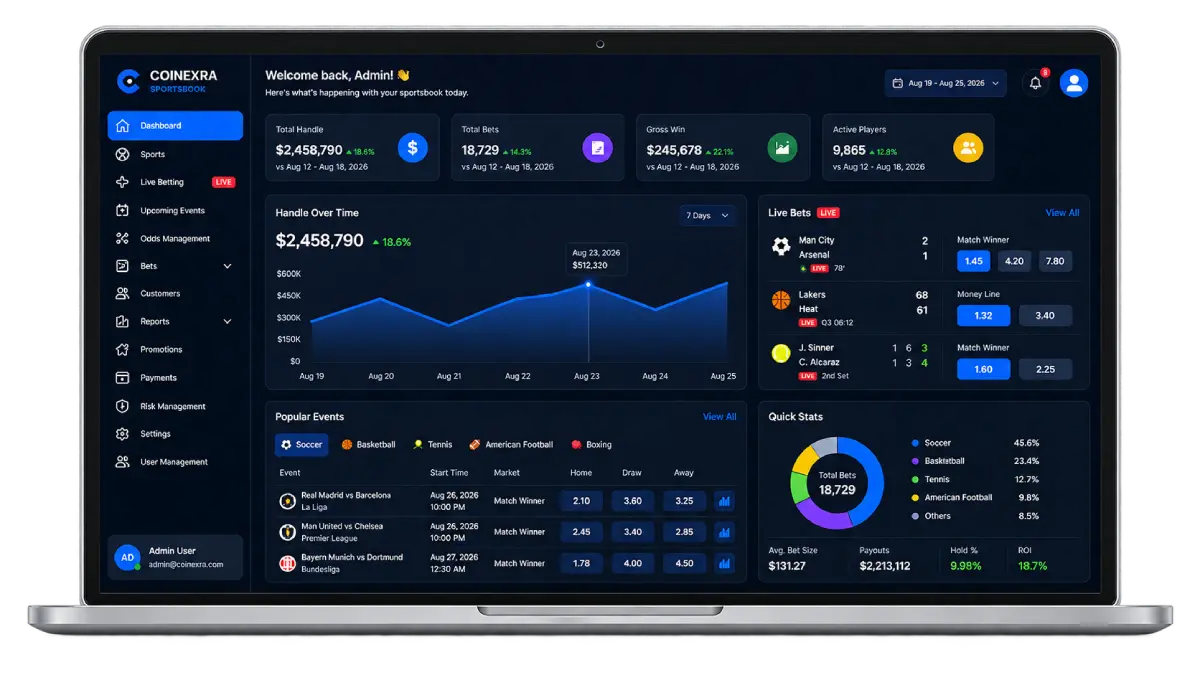
Starting a sportsbook business involves much more than creating a betting website and adding sports odds. A successful sportsbook combines a clear business model, a legally compliant operating structure, a strategy for acquiring and retaining customers, and more. For entrepreneurs researching how to start a sportsbook business, the first decision should not be which software provider to choose.
It should be understanding the market you want to enter, the players you want to serve, and the infrastructure required to operate the business sustainably. In this guide, you will get a clear breakdown that explains each stage and the key decisions an entrepreneur should make before launching an online sportsbook.
What Does It Take to Start a Sportsbook Business?
Unlike a simple website, the sportsbook platform's underlying operation has to process real-time betting activity while maintaining accurate event data, secure transactions, and regulatory compliance. So before launching your sportsbook platform, these are all the things the operator typically needs to establish:
- A defined target market and customer segment
- A suitable sportsbook business model
- A legally appropriate jurisdiction and licensing strategy
- Sportsbook software and backend infrastructure
- Sports data and odds feeds
- Betting, trading, and risk-management capabilities
- Player wallets and payment infrastructure
- KYC, AML, fraud-prevention, and responsible-gambling controls
- Customer acquisition and retention channels
- Customer support and operational teams
- Financial reserves for ongoing operations and player payouts
The important point is that these components cannot be planned independently.
How to Start a Sportsbook Business: Step-by-Step
The steps below break down the process in the order an entrepreneur should approach it, helping you understand what needs to be decided, built, integrated, and validated before taking a sportsbook live.
1. Define Your Sportsbook Business Model
2. Choose the Target Market and Sports Betting Jurisdiction
3. Understand Sportsbook Licensing and Legal Requirements
4. Choose How You Will Build Your Sportsbook
5. Select the Sportsbook Technology Stack
6. Platform Infrastructure that Your Sportsbook Needs
7. Build the Payment and Player Wallet Infrastructure
8. Implement KYC, AML, Fraud Prevention, and Responsible Gambling
9. Create Your Sportsbook Revenue Model
10. Launch and Acquire Players for Your Sportsbook
Step 1: Define Your Sportsbook Business Model
The first step in starting a sportsbook is deciding what kind of operator you want to build. Start by defining the fundamentals of the business:
- Target audience
- Geographic focus
- Sports coverage
- Betting experience
- Brand positioning
- Acquisition strategy
Without clear answers, it is easy to spend heavily on technology and marketing without building a sustainable customer base.
Step 2: Choose the Target Market and Sports Betting Jurisdiction
Once the business model is defined, determine where you can operate, because jurisdiction is one of the most important decisions, as it affects betting licensing and operations. There is no universal sportsbook license that automatically gives an operator permission to accept bets everywhere, licensing requirements vary by jurisdiction.
Before selecting a jurisdiction, evaluate:
- Legal status of online sports betting
- Licensing requirements
- Application and ongoing regulatory costs
- Taxation structure
- Permitted sports and betting markets
- Advertising and promotional restrictions
- KYC and AML obligations
- Responsible-gambling requirements
- Payment and banking availability
- Data-protection requirements
- Market size and player demand
- Competition from existing operators
Your target market should therefore be selected before committing to a sportsbook technology stack.
Step 3: Understand Sportsbook Licensing and Legal Requirements
Licensing is not simply a document needed before launch. It shapes how the sportsbook can operate. A licensing strategy should cover both the legal entity operating the business and the technical & operational controls required by the relevant regulator.
Depending on the jurisdiction, the operator may need to demonstrate:
- Corporate ownership and management information
- Financial capability and source-of-funds documentation
- Technical systems and security controls
- KYC and age-verification procedures
- AML and transaction-monitoring processes
- Responsible-gambling policies
- Player funds and payment procedures
- Data-protection controls
- Complaint and dispute procedures
- Reporting and audit capabilities
- Operational policies and internal controls
The licensing path should therefore be planned alongside the technology architecture rather than treated as a final administrative task.
Step 4: Choose How You Will Build Your Sportsbook
Once the market and regulatory direction are clear, decide how the sportsbook itself will be built. There are three broad approaches:
Custom Sportsbook Development
A custom sportsbook means building the core technology specifically for your business. This approach can provide:
- Maximum architectural control
- Extensive customization
- Proprietary features
- Greater control over long-term technology decisions
- Ability to build a highly differentiated product
However, it also requires significantly more capital, technical resources, testing, and development time.
Turnkey Sportsbook Platform
The turnkey platform provides prebuilt sportsbook infrastructure that can be configured and integrated for the operator. It can reduce the amount of core technology that needs to be developed internally while still providing more operational flexibility.
White Label Sportsbook
Coinexra’s white-label sportsbook provides a ready-to-deploy technology foundation that can be branded and configured for the operator's business. This approach can help businesses:
- Reduce initial development complexity
- Accelerate time to market
- Avoid building every sportsbook component from scratch
- Add integrations without developing the complete underlying betting infrastructure
Choose the model based on your capital, target market, desired launch speed, and long-term technology strategy.
Step 5: Select the Sportsbook Technology Stack
Your sportsbook technology should be evaluated as an entire operating ecosystem, not simply as a website interface. The architecture should allow different components to work together while giving the operator centralized control over betting operations. A capable sportsbook technology stack should consider:
Frontend: React, Vue, Angular, etc.
Backend: Node.js, Java, PHP, Python, etc.
Database: PostgreSQL, MySQL, MongoDB, etc.
APIs: REST, GraphQL, WebSockets
Cloud/infrastructure: AWS, Azure, Google Cloud, etc.
Caching: Redis, etc.
Security: encryption, authentication, RBAC, MFA
DevOps: CI/CD, containers, monitoring, load balancing
Coinexra's white-label sportsbook follows an API-driven model connecting player applications with the sportsbook core, betting engine, odds engine, trading and risk engine, wallet and player management, administration, reporting, and third-party integrations.
Step 6: Platform Infrastructure that Your Sportsbook Needs
Once the core sportsbook technology is selected, the next priority is connecting the infrastructure that powers the actual betting experience. These systems work together behind the scenes to determine what markets players see and how the operator manages its exposure
- Player registration and authentication
- Player profiles
- Betting engine
- Pre-match betting
- Live betting
- Bet slip
- Cash-out functionality where applicable
- Multiple bet types
- Odds management
- Trading tools
- Risk controls
- Liability management
- Player wallet
- Deposits and withdrawals
- KYC and AML integrations
- Fraud prevention
- Bonus and promotion management
- CRM
- Affiliate management
- Analytics
- Reporting
- Administrative controls
- API integrations
- Multi-language capabilities
- Multi-currency capabilities
- Web and mobile access
This interconnected infrastructure is what allows a sportsbook to offer a reliable betting experience while maintaining control over its financial and operational risk.
Step 7: Build the Payment and Player Wallet Infrastructure
A sportsbook is also a financial transaction platform. Players need to deposit funds, maintain balances, receive settlements, and withdraw available funds. So your payment infrastructure should support the complete transaction lifecycle.
Depending on the market and applicable regulations, payment options may include:
- Credit and debit cards
- Bank transfers
- E-wallets
- Local payment methods
- Digital assets or cryptocurrency where legally permitted
A sportsbook with attractive odds can still struggle to retain players if deposits repeatedly fail or withdrawals become unnecessarily difficult.
Step 8: Implement KYC, AML, Fraud Prevention, and Responsible Gambling
Compliance should be built into the sportsbook rather than added immediately before launch. Depending on the jurisdiction, a sportsbook may need capabilities such as:
- Age verification
- KYC/AML
- Identity verification
- Player risk assessment
- Transaction monitoring
- Suspicious-activity monitoring
- Deposit or wagering limits
- Cooling-off mechanisms
- Account restrictions
- Fraud detection
Coinexra's sportsbook infrastructure includes capabilities such as KYC/AML integrations, MFA, role-based access controls, fraud-prevention mechanisms, PCI DSS-oriented payment security, GDPR-aligned data handling, and more.
Step 9: Create Your Sportsbook Revenue Model
Before launching, you need to understand how the sportsbook will generate and retain revenue. Potential revenue channels can include:
- Sportsbook margin
- Betting spread
- Commission-based models
- Affiliate-driven revenue
- VIP/Premium memberships
- Advertising opportunities
A sportsbook can generate substantial betting activity and still struggle financially if acquisition costs, bonuses, payment costs, or risk losses are poorly controlled.
Step 10: Launch and Acquire Players for Your Sportsbook
Launching the platform is not the end of development. It is the beginning of sportsbook operations. Before going live, complete a structured launch review.
- Technology Readiness
- Compliance Readiness
- Business Readiness
Once the platform is ready, avoid treating acquisition as simply a matter of offering the largest possible bonus. A sustainable acquisition strategy should acquire valuable and compliant players, not simply maximize registrations.
White Label vs Custom Sportsbook: Which Is Better for a New Operator?
The choice between custom development and white-label infrastructure largely depends on how much control you need versus how quickly you want to enter the market.
| Factor | Custom Sportsbook | White Label Sportsbook |
| Development | Built from the ground up | Prebuilt infrastructure |
| Time to market | Longer | Faster |
| Initial technical workload | High | Lower |
| Customization | Very high | High, depending on provider |
| Internal development team | Usually substantial | Smaller technical requirement |
| Maintenance | Operator-heavy | Provider-supported |
| Infrastructure ownership | Greater | Provider-dependent |
| Best suited for | Large, technology-led operators | Entrepreneurs and operators seeking faster market entry |
Custom development can make sense when proprietary technology is central to the company's advantage and the business has a long development lifecycle. White-label infrastructure can make more sense when the priority is to validate a market, establish a betting brand, and launch faster.
Coinexra’s ready-to-deploy white-label sportsbook can be customized based on betting, player management, odds and trading, payments, compliance integrations, and even multi-channel capabilities.
What Features Should You Look for in Sportsbook Software?
Choosing sportsbook software requires looking beyond the visible betting interface. The platform should provide the infrastructure required to operate, manage, and scale the business.
Player Management
Player management should give operators control over the complete customer lifecycle. Important capabilities should include:
- Registration
- Secure login
- Player profiles
- KYC integration
- Account verification
- Wallet management
- Betting history
- Transaction history
- Player segmentation
- Bonus management
- Account restrictions
Betting
The betting layer is the core customer-facing component of the sportsbook. Look for:
- Pre-match betting
- Live betting
- Bet slip
- Multiple bet types
- Multi bets
- System bets
- Cash-out functionality where applicable
- Betting history
- Market navigation
- Search and filtering
- Real-time odds updates
The objective should be to make the betting journey fast and intuitive while maintaining accurate market and settlement information.
Trading
Trading functionality controls the commercial and financial side of sportsbook operations. Important capabilities include:
- Odds-feed integration
- Odds management
- Risk controls
- Liability monitoring
- Stake limits
- Market suspension
- Automated trading
- Manual trading
- Exposure monitoring
- Betting-pattern analysis
A sportsbook should not simply maximize the number of available markets. It should provide the operator with sufficient control to manage the risk associated with those markets.
Payments
Payment infrastructure should cover both traditional transactions and market-specific payment requirements. Look for:
- Card payments
- Bank transfers
- E-wallet integration
- Local payment methods
- Cryptocurrency payments where permitted
- Deposits
- Withdrawals
- Transaction tracking
- Payment reconciliation
- Fraud controls
- Multi-currency support
Payment flexibility can be particularly important when expanding into multiple geographic markets.
Business & Management
The administrative layer determines how efficiently the operator can run the sportsbook. Useful capabilities include:
- Centralized admin dashboard
- User management
- CRM
- Affiliate management
- Referral management
- Analytics
- Risk management
- Role-based permissions
- Audit logs
A strong administrative system allows operators to make operational decisions without depending on developers for every routine configuration.
Common Mistakes to Avoid When Starting a Sportsbook Platform
Understanding these common mistakes before launch can help you avoid unnecessary costs and build a sportsbook on a foundation that is prepared for sustainable growth.
Mistake 1: Choosing Software Before Choosing a Market
One of the biggest mistakes is selecting a platform before deciding where the sportsbook will operate. Define the target market first and then select technology that supports it.
Mistake 2: Treating Licensing as an Afterthought
Licensing can affect the entire operating model. Delaying the regulatory assessment can result in expensive technology changes later. Map the licensing and compliance requirements before finalizing the technology architecture.
Mistake 3: Underestimating Payment Infrastructure
A sportsbook needs more than a deposit button. Failed deposits and weak transaction monitoring can directly affect customer trust. Design deposits, withdrawals, verification, and reconciliation as one payment ecosystem.
Mistake 4: Using Weak Odds or Data Providers
Outdated or unreliable data can result in inaccurate markets and poor user experiences. Evaluate latency, reliability, market depth, settlement processes, and integration capabilities before selecting a provider.
Mistake 5: Ignoring Trading and Risk Management
A sportsbook cannot be managed effectively through betting software alone. Exposure and liability need continuous monitoring. Establish clear risk rules, trading controls, and monitoring processes before opening the platform to significant betting volume.
Mistake 6: Building Too Many Features Before Launch
Trying to launch every possible sport, market, bonus system, and advanced feature can increase development time without proving that the business model works. Launch with the capabilities required for your target market and expand based on measurable demand.
Mistake 7: Ignoring Responsible Gambling Requirements
Player protection is both a regulatory requirement in many markets and an important component of responsible sportsbook operations. Build applicable age verification, limits, monitoring, and responsible-gambling processes into the platform from the beginning.
Mistake 8: Choosing a Vendor Based Only on Price
The cheapest sportsbook platform is not necessarily the lowest-cost option over the lifetime of the business. Evaluate the provider based on technology, integrations, security, scalability, support, customization, deployment process, and total cost of ownership.
Start Your Sportsbook Business With Ready-to-Deploy Sports Betting Infrastructure
Building every sportsbook component from scratch requires substantial development resources, time, and effort. But a ready-to-deploy white-label approach allows entrepreneurs to start with established sportsbook infrastructure and customize the platform around their brand and business requirements.
Coinexra's white-label sportsbook software provides a configurable foundation covering everything the business needs to run a successful sports betting operation, such as player management, pre-match and live betting, odds and trading, risk controls, wallet management, payments, administration, bonuses, KYC/AML integrations, fraud prevention, analytics, and third-party integrations. We also help you launch your platform for web, Android, iOS, and PWA deployment based on your business plan.
For businesses that want to focus their resources on branding, customer acquisition, and growth instead of building the entire betting infrastructure from scratch, a white-label sportsbook can provide a practical route to market.
Frequently Asked Questions
How to Start a Sportsbookie Business?
To start a sports betting business, first define your target market and business model, identify the applicable licensing requirements, select an appropriate sportsbook technology model, integrate sports data and odds, establish payments and player wallets, implement KYC/AML and responsible-gambling controls, test the platform, and then launch with a structured acquisition and retention strategy.
How Much Does It Cost to Start a Sportsbook?
The cost to launch sports betting software varies significantly by jurisdiction, licensing structure, operational reserves, and more.
A custom sportsbook generally requires $50,000 - $100,000 due to more development resources than a ready-to-deploy white-label platform. Coinexra's white-label sportsbook software cost falls around $10,000 - $25,000, depending on customization, jurisdictions, and third-party integrations.
How Long Does It Take to Launch a Sportsbook?
Custom development can require 3 - 6 months due to its longer development cycle, core sportsbook infrastructure has to be built and tested from the ground up. A ready-to-deploy white-label platform can significantly reduce the technology deployment timeline.
Coinexra can launch your betting platform in approximately 4 - 8 weeks with a white-label sportsbook, while noting that custom development can take considerably longer.
Do I Need a License to Start an Online Sportsbook?
Yes, if you intend to operate a regulated sportsbook, you generally need the authorization required by the jurisdiction in which you operate and accept bets. The exact licensing structure varies considerably by country and, in some cases, by state or territory.
Can I Start a Sportsbook Without Building the Software From Scratch?
Yes. Businesses can use turnkey or white-label sportsbook infrastructure instead of developing every component internally. Coinexra's white-label platform can provide prebuilt capabilities such as betting, player management, wallets, payments, and more.
What Is the Difference Between a White Label and a Custom Sportsbook?
A custom sportsbook is developed specifically for the operator and provides greater control over the underlying technology and architecture. However, it requires considerably more development resources, testing, maintenance, and time.
A white-label sportsbook uses existing infrastructure that can be branded and configured for the operator. It generally provides a faster route to market while reducing the need to develop the entire sportsbook technology stack from scratch.
How Do Sportsbooks Make Money?
Sportsbooks primarily generate revenue from the margin embedded in their betting markets. Additional revenue opportunities can include commissions, affiliate channels, VIP programs, premium memberships, cross-selling, advertising where permitted, and other approved products or services.