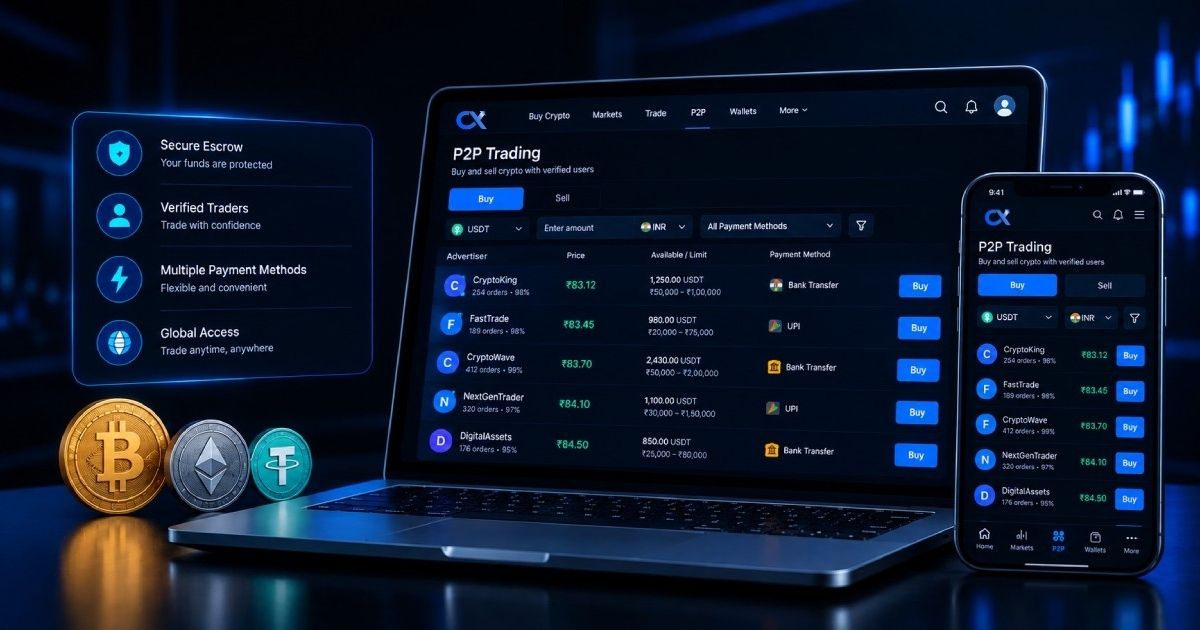

An OTC Crypto Exchange Script is a pre-built, customizable software solution for launching a secure over-the-counter cryptocurrency trading platform. It provides core workflows for handling private quote requests, negotiated trades, execution, settlement, and transaction records without requiring businesses to build the entire platform from scratch.
Coinexra’s OTC Crypto Exchange Script provides a configurable foundation for businesses planning to launch an OTC trading desk or add OTC capabilities to an existing digital asset platform. Depending on the deployment requirements, the solution can be tailored to support client onboarding, RFQ workflows, dealer operations, liquidity connectivity, settlement tracking, and administrative controls.
What Is an OTC Crypto Exchange?
An OTC crypto exchange is a trading platform or OTC desk that facilitates cryptocurrency transactions and is a bridge between counterparties rather than relying entirely on a public order book.
An OTC exchange is best suited for large or specialized transactions, where customers may want greater control over execution, pricing, privacy, or settlement than a regular market order can provide. OTC exchange differs from a traditional exchange. It brings together the trading desk, customer relationship, pricing, execution, settlement, and operational processes required to complete a negotiated transaction.
How Does an OTC Crypto Exchange Work?
OTC crypto trading typically follows a more tailored process than standard order-book trading, with each transaction handled purely according to the needs of the buyer and seller.
Client Onboarding and Verification
Before a customer can conduct OTC transactions, the business needs to establish who the customer is and whether they meet the platform's requirements. Individual users may undergo KYC, while businesses and institutional clients may require KYB, beneficial ownership verification, and additional due diligence, only then are they given authorization to access trading features.
Trade Request and RFQ
After verification and approval, the customer proceeds to submit a request for any particular asset, quantity, and trading direction. This is often handled through a Request for Quote, or RFQ, unlike a conventional market order.
Quote Generation
Once the trade details are clear, the OTC desk works out a price that reflects the current market and the specifics of the transaction. The size of the order, available market conditions, and the desk’s ability to complete the trade all influence the final offer. The client can then review the quoted price within the agreed window and further decide.
Quote Acceptance and Execution
Once the client receives the quote, they can review the proposed terms and decide whether the trade meets their requirements. If the quote is accepted, the OTC desk confirms the transaction and moves it forward for execution. At this stage, the agreed trade details are locked in so both sides maintain a record of the accepted quote and trade terms.
Settlement
After the trade has been executed, the parties complete the agreed asset and payment transfers according to the transaction terms. The cryptocurrency, fiat currency, or both are delivered through the agreed settlement process. The platform keeps the settlement process visible, making it easier to track pending transfers, completed transactions, and any issues that require attention.
Trade Reconciliation
Once the transaction has been settled, the business must reconcile the completed trade against its financial and operational records. Reconciliation brings together the trade details, funds transferred, fees charged, and resulting account balances so the business can confirm that everything matches the original transaction.
OTC Crypto Exchange vs Traditional Crypto Exchange
Both models facilitate cryptocurrency trading, but they are designed around different trading experiences.
| Aspect | OTC Crypto Exchange | Traditional Crypto Exchange |
| Execution | Negotiated or RFQ-based | Primarily order-book based |
| Pricing | Quote negotiated for a specific transaction | Price formed through bids and asks |
| Transaction visibility | Typically not displayed as a public order-book order | Orders and trades may be visible according to venue rules |
| Trade requirements | Often suited to large or specialized trades | Supports retail and institutional orders |
| Customer interaction | May involve dealers or relationship managers | Primarily platform-driven |
| Settlement | Arranged according to the trade and platform model | Follows the exchange's settlement procedures |
| Market impact | May reduce direct order-book exposure | Large orders can consume available order-book liquidity |
Traditional exchanges suit routine order-book trading, while OTC services are useful when transactions require negotiated pricing, dealer support, or coordinated settlement.
OTC Crypto Exchange Use Cases
OTC trading has several use cases: for some businesses, it can be a pathway to handle larger client transactions, and for others, it can be an important part of their overall crypto offering.
Institutional Trading
Institutional clients often approach digital asset trading as part of a broader investment or treasury strategy rather than regular individual trading. Such traders need a trading environment that fits into their existing processes and gives their teams greater visibility over how transactions are handled. An OTC operation perfectly fits into this pocket by making crypto easy to manage.
Corporate Treasury Management
Companies holding digital assets may need to acquire, convert, or rebalance substantial positions as part of their treasury activities. OTC execution can give treasury teams a more organized process for handling these transactions.
High-Net-Worth Crypto Trading
Large individual investors may prefer private execution and direct interaction with an OTC desk when their transaction requirements are considerably larger than ordinary retail orders.
Crypto Brokerage Services
Brokers can incorporate OTC capabilities into their services to facilitate larger customer transactions while maintaining a dedicated trading and settlement workflow.
Mining and Digital Asset Businesses
Businesses that regularly receive or hold substantial amounts of cryptocurrency may need an efficient way to convert or manage those assets. An OTC operation can provide a dedicated channel for handling such activity.
Features of OTC Crypto Exchange Script
A capable OTC platform needs to support the entire transaction lifecycle rather than simply provide a trading screen. Coinexra's OTC Crypto Exchange Script can be configured around the operational requirements of an OTC trading business.
RFQ-Based Trading
The RFQ workflow allows customers to submit requests for specific assets, trade directions, and quantities. Dealers can review requests, generate quotes, and manage responses within the defined trading process.
Dealer and Trading Desk Management
A dedicated trading environment gives OTC dealers a central place to manage the flow of customer transactions from request to completion. Dealers can review incoming requests, manage quotes, monitor trade status, and coordinate execution and settlement.
Quote Management
Dealers can create and share trade quotes, define validity periods, and manage quote status. Where supported, pricing updates can account for changing market conditions before a customer accepts the quote.
Fiat and Crypto Settlement
The platform can track settlement instructions, payment status, asset transfers, and outstanding actions. Available fiat payment methods and crypto settlement workflows depend on the integrations and operating model.
Wallet and Custody Integration
Wallet and custody integrations allow the platform to connect trading activity with the systems responsible for holding and transferring digital assets.
Liquidity Provider Connectivity
External liquidity sources can be connected to the platform when the business needs access to additional execution capacity or market depth.
KYC/KYB and AML Integration
The platform can integrate with appropriate identity verification, business verification, AML, sanctions screening, and other compliance services required by the operator.
Role-Based Access Controls
Different access levels can be assigned to dealers, administrators, compliance personnel, finance teams, and other internal users so that operational responsibilities remain properly separated.
Trade and Settlement Management
The OTC crypto trading platform maintains visibility across the transaction lifecycle, allowing teams to track requests, confirmed trades, settlement status, fees, and related records.
Reporting and Analytics
Trading and operational data can be organized into reports that help the business monitor activity, reconcile transactions, understand revenue, and maintain appropriate records.
API Integration
API connectivity allows the platform to communicate with external liquidity providers, custody systems, compliance services, payment infrastructure, and other business applications.
Security and Compliance in an OTC Crypto Exchange
OTC crypto platforms often process high-value transactions and sensitive customer information, making security and compliance important parts of the platform architecture.
Account and Access Security
Customer and internal accounts should be protected through appropriate authentication and access controls. Multi-factor authentication and controlled permissions can provide additional protection against unauthorized access.
Wallet and Custody Protection
Digital assets require carefully controlled custody and transfer procedures. Depending on the business model, the platform can work with suitable custody infrastructure and wallet controls to manage asset movement securely.
Transaction Monitoring
Monitoring transactions helps the business identify activity that requires additional review. The platform can connect with appropriate blockchain analytics and compliance systems to support this process.
KYC, KYB and AML
Customer and business verification provides the foundation for establishing who is using the platform. AML procedures can then be applied according to the customer's risk profile, transaction activity, and applicable regulatory requirements.
Audit Trails
A clear record of account activity, trade events, administrative actions, and settlement information allows the business to investigate transactions and maintain appropriate operational and regulatory records.
The exact compliance framework should always be determined according to the jurisdiction, services offered, customer base, and regulatory obligations of the business.
OTC Crypto Exchange Business Models
The way an OTC business earns revenue and manages transactions depends heavily on how it positions itself between the customer and the market. Choosing the operating model early is important because it influences the company's exposure to trading risk, its relationship with liquidity providers, and the type of service it can offer customers.
Principal OTC Desk
A principal OTC desk buys or sells cryptocurrency directly to the customer using its own inventory. The business earns from the difference between its buying and selling prices and takes responsibility for the assets involved in the trade.
Agency OTC Desk
An agency OTC desk does not normally use its own inventory to complete customer trades. Instead, it acts on the customer's behalf, finding a suitable counterparty and arranging the transaction in exchange for a commission or service fee.
Broker-Based OTC Platform
A broker-based OTC model brings buyers and sellers together without necessarily taking ownership of the assets being traded. Its main role is to find a suitable match, help both parties agree on the terms, and facilitate the transaction.
Institutional OTC Trading Model
An institutional OTC trading model is designed for organizations that trade digital assets as part of their investment, treasury, or fund operations. They don’t have to focus on individual retail trades; the business builds its OTC service around ongoing institutional accounts and their trading relationships.
Hybrid OTC and Exchange Model
A hybrid model is a combo of both OTC trading and regular exchange trading under the same platform. A hybrid platform is a win-win for both user bases, as traders use the exchange for everyday market activity while turning to the OTC desk when a transaction calls for it.
Revenue Models for an OTC Crypto Exchange
An OTC business can generate revenue in several ways, and the most suitable approach depends on whether the operator acts as a principal, agency desk, broker, or hybrid service provider.
Trading Spreads
A principal OTC desk can earn revenue from the difference between its asset acquisition price and the price quoted to customers. Spreads may vary with market volatility, liquidity costs, trade size, and customer demand.
Transaction Fees
The business can charge customers a fee based on the value or structure of a completed transaction. Fees can be standardized or adjusted according to customer tiers and trading arrangements.
Brokerage Commissions
An agency- or broker-based OTC business can earn commissions for arranging and facilitating trades. Since the business is primarily providing access and execution rather than taking the full principal position, commission-based revenue can fit naturally into this model.
Premium OTC Services
Businesses serving professional clients can generate additional revenue through specialized OTC services where the customer is paying for a higher level of execution support, relationship management, or settlement coordination.
Institutional Account Fees
An operator can also structure recurring account or service fees for institutional customers where the business provides an ongoing OTC relationship rather than isolated transactions.
Settlement-Related Fees
Where the business provides specialized settlement services, appropriate service charges can provide another source of revenue, subject to the operator's business model and regulatory requirements.
The strongest revenue strategy is not necessarily the one with the highest individual fee. Customer retention, transaction volume, execution quality, liquidity costs, operational expenses, and compliance overhead all affect the actual profitability of an OTC business.
OTC Crypto Exchange Script vs Custom-Built Platform
Businesses entering the OTC market generally have two technology paths. They can develop their platform from the ground up or begin with a pre-built OTC exchange solution and adapt it to their requirements.
Custom development offers extensive control, but it also places the responsibility for designing, developing, testing, securing, integrating, and maintaining every major component on the business or its technology partner.
An OTC exchange script starts with an existing foundation. This can shorten the path between the initial business idea and a functioning OTC operation while still allowing the platform to be adapted to the company's requirements.
| OTC Exchange Script | Custom-Built Platform |
| Starts with an existing software foundation | Starts with requirements and architecture design |
| Existing workflows can reduce initial engineering effort | Workflows are designed around specific requirements |
| Customization depends on the solution's architecture | Greater control over architecture and implementation |
| Launch timeline depends on configuration and integrations | Timeline depends on scope and development complexity |
| Initial software costs may be lower | Requires investment in design and implementation |
| Updates depend on the product and vendor arrangement | Updates can be managed according to the ownership model |
The choice ultimately comes down to the business's priorities. An OTC exchange script may suit businesses seeking a quicker route to market with an established software foundation. Custom development may be preferable when proprietary trading logic, specialized integrations, or greater architectural control are central requirements.
Why Choose Coinexra for an OTC Crypto Exchange Script?
Launching an OTC trading operation requires more than a customer-facing trading interface. Businesses need a way to manage quote requests, dealer workflows, transaction execution, settlement, and administrative controls within a coordinated platform.
Coinexra's OTC Crypto Exchange Script provides a configurable software foundation for businesses looking to launch an OTC trading platform or extend an existing digital asset offering. Businesses exploring a Cryptocurrency exchange platform script can adapt the solution to their requirements, with available features and integrations determined by the agreed implementation scope.
Proven Blockchain Expertise
Coinexra considers building an OTC crypto exchange much more than understanding crypto transactions. The underlying tech needs to mesh with many operational requirements of a live trading business. We bring our blockchain and cryptocurrency technology expertise to the table for the development and deployment of OTC trading solutions. We make sure the solution helps the platform become a part of a broader digital asset operation rather than treating it as an isolated trading interface.
Custom-Built Scripts
Every OTC business has its own trading model, customer requirements, supported assets, settlement processes, and operational preferences. A rigid, one-size-fits-all product can become restrictive as soon as those requirements start to differ. Therefore, Coinexra customized the OTC Exchange script under the business's intended workflow, including branding, trading processes, integrations, user roles, supported assets, settlement requirements, and other business-specific needs.
Top-Tier Security
We know well that traders opt for an OTC exchange for high-value transactions. Keeping that in mind, we have engineered the script to have exceptional security across the platform, account access, transaction workflows, wallet integrations, permissions, and administrative operations. Appropriate security mechanisms can be incorporated according to the business's requirements and custody model, helping establish stronger controls around sensitive trading and asset-management activities.
Post-Launch Support
Coinexra doesn’t stop at providing you with a solution, but rather continues to partner throughout the life of the exchange, providing integrations as needed. Factors like workflows needing adjustment, security patches, and the platform may need to adapt as trading volumes increase. We ensure the right tech support is provided to help businesses maintain, improve, and extend their OTC platform after deployment.
Business-Focused Implementation
Coinexra works with businesses to understand their intended market, trading model, operational requirements, and growth plans before shaping the platform around those needs. Coinexra’s business-focused approach helps ensure that the OTC Crypto Exchange Script is not simply a collection of trading features, but a practical foundation for launching and operating an OTC digital asset business.
Frequently Asked Questions
What is an OTC crypto exchange script?
An OTC Crypto Exchange Script is a customizable software solution for launching an over-the-counter cryptocurrency trading platform. It can provide workflows for quote requests, negotiated trades, execution, settlement, and administration, depending on the product's capabilities.
Why do traders use OTC crypto exchanges?
Traders use OTC services to arrange large or specialized cryptocurrency transactions through negotiated pricing, dealer support, and coordinated execution or settlement. The benefits depend on the transaction and operating model.
Who uses OTC crypto trading platforms?
OTC platforms are commonly relevant to institutional investors, crypto funds, hedge funds, corporate treasuries, high-net-worth individuals, miners, brokers, and other businesses involved in substantial digital asset transactions.
How does an OTC crypto exchange generate revenue?
An OTC business can generate revenue through trading spreads, transaction fees, brokerage commissions, premium services, institutional account fees, and other applicable service charges. The appropriate combination depends on the business model.
Can an OTC crypto exchange support fiat transactions?
Yes. An OTC platform can support fiat-to-crypto, crypto-to-fiat, or crypto-to-crypto settlement depending on the business model, banking and payment relationships, supported currencies, and regulatory requirements.
Is an OTC crypto exchange script customizable?
Yes. Coinexra's OTC Crypto Exchange Script can be configured around supported trading workflows, branding, user roles, assets, and integrations, subject to the product's capabilities and agreed implementation scope.
What integrations does an OTC crypto exchange need?
The integrations depend on how the business operates. Common requirements can include liquidity providers, wallets, custody services, KYC/KYB providers, AML and blockchain analytics services, banking or payment infrastructure, and internal business systems.
Is an OTC crypto exchange secure?
Of course. Coinexra considers Security our ironclad priority. A well-built and battle-tested exchange will guarantee you a secure platform that earns you a plethora of revenue streams as the platform grows.
Security depends on the platform architecture, access controls, wallet and custody arrangements, integrations, and operational procedures. Relevant safeguards may include multi-factor authentication, role-based permissions, transaction monitoring, and audit trails.
How can I launch an OTC crypto exchange with Coinexra?
You can begin by defining your target market, OTC business model, supported assets, settlement requirements, integrations, and regulatory needs. Get in Touch with our team for a more detailed picture.