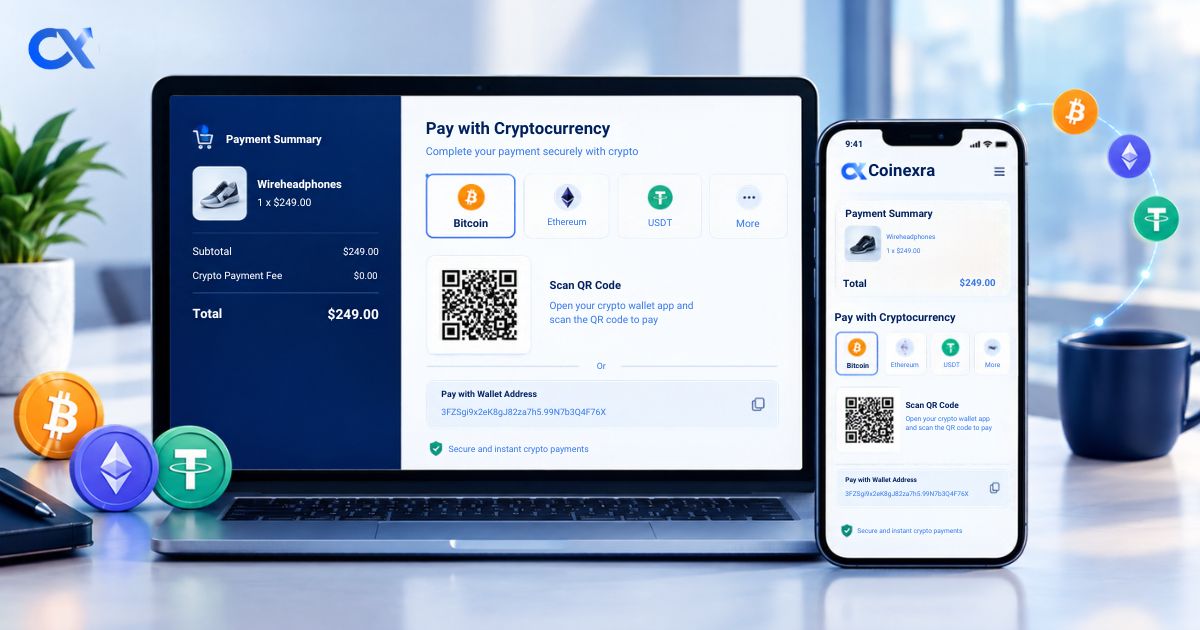
Cryptocurrency wallets have evolved from simple tools for storing and transferring digital assets into full-fledged platforms that support token swaps, staking, DeFi applications, NFTs, fiat on-ramps, and multi-chain transactions, making them an important component of today’s broader digital asset ecosystem.
Businesses see this as an opportunity to launch a crypto wallet to generate revenue through transaction fees, swap fees, subscriptions, staking services, partner commissions, and other financial services.
But before development begins, businesses need to make an important strategic decision:
Should you launch a crypto wallet using white label software, or should you build a crypto wallet from scratch?
A white label crypto wallet provides ready-made wallet infrastructure that can be customized and branded for your business, while building from scratch gives you complete control over the wallet's architecture, features, security, and user experience. This guide explains both approaches that businesses should consider before launching a crypto wallet.
What Is a Crypto Wallet?
A crypto wallet is a hardware or software-based solution that enables users to access, manage, and transfer digital assets on blockchain networks. Unlike a traditional bank account, a crypto wallet does not typically store cryptocurrency itself. Instead, it manages the cryptographic keys and credentials required to authorize transactions and interact with assets recorded on a blockchain.
Depending on its architecture and supported blockchain networks, a wallet can provide a wide functionality range, from basic asset management to advanced Web3 interactions, NFT management, decentralized application connectivity, and even more. For businesses, a crypto wallet can be developed as a standalone product or integrated into a broader digital asset ecosystem, including cryptocurrency exchanges, fintech platforms, Web3 applications, payment platforms, neobanks, and other financial products.
Why Businesses Should Create a Crypto Wallet?
The growing adoption of digital assets has increased the need for secure and convenient infrastructure for managing cryptocurrencies across different blockchain networks. Within the digital asset ecosystem, a crypto wallet can become a core component of a broader digital asset product or financial ecosystem.
By integrating a crypto wallet, businesses can give users a dedicated environment to interact with digital assets while creating additional revenue-generating opportunities.
Businesses may develop a crypto wallet to:
- Launch a branded cryptocurrency wallet
- Provide custody or non-custodial asset management
- Add crypto payments to an existing platform
- Offer token swaps
- Integrate DeFi services
- Support Web3 applications
- Enable NFT management
- Build a crypto trading ecosystem
- Offer staking services
- Create additional revenue streams
However, launching a crypto wallet involves considerably more than developing an interface for sending and receiving cryptocurrency. Businesses must make decisions around the custody model, private-key management, and blockchain infrastructure.
Two Ways to Create a Crypto Wallet
When planning a crypto wallet, the development approach you choose can have a significant impact on your launch timeline, development effort, and long-term maintenance requirements. There are two primary approaches businesses can consider when creating a crypto wallet:
Option 1: Launch a White Label Crypto Wallet
A white label crypto wallet is a pre-built wallet solution that can be customized with a company's branding, user interface, supported assets, features, and business-specific requirements tailored to the brand identity.
Rather than engineering every wallet component from the ground up, you begin with an existing wallet infrastructure and configure or extend it according to the product's requirements. This can reduce the amount of core infrastructure development required before launch while allowing the product to be adapted to a specific market.
A white label crypto wallet may include capabilities such as:
- Multi-chain wallet support
- Multi-asset management
- Wallet creation
- Send and receive transactions
- Token swaps
- Security controls
- Transaction history
- Portfolio tracking
- Admin dashboard
- API integrations
- dApp connectivity
- Staking integration
- NFT support
How to Launch and Customize a White-Label Crypto Wallet?
A white-label crypto wallet typically works as pre-built infrastructure that can be customized and configured around the requirements of the business launching the product. The following process illustrates how businesses can set up, customize, and launch a white-label crypto wallet:
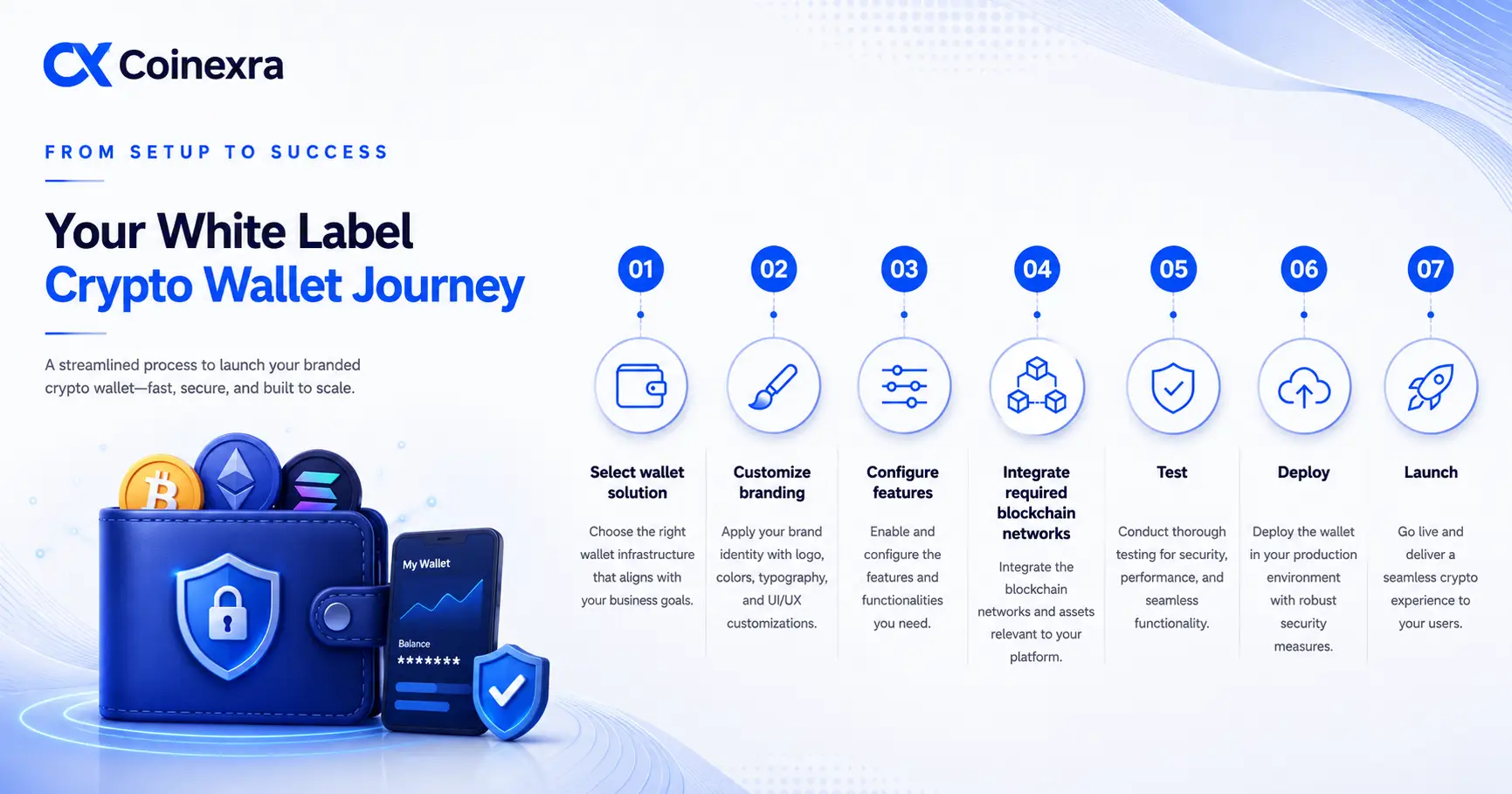
The exact level of customization depends on the underlying wallet infrastructure.
Businesses can typically customize elements such as:
- Logo and brand identity
- Colors and user interface
- Supported cryptocurrencies
- Blockchain networks
- Wallet features
- Transaction settings
- Fee structures
- User management
- Admin controls
- Third-party integrations
Advantages of a White Label Crypto Wallet
A white label crypto wallet can provide a practical alternative to building wallet infrastructure instead of building the wallet entirely from the ground up. By starting with pre-built components, organizations can focus more on market expansion while reducing the amount of core infrastructure that needs to be developed internally. The key advantages include:
Faster Deployment
Existing wallet infrastructure can shorten the development cycle by reducing the amount of core functionality that needs to be built and tested from scratch.
Lower Initial Development Effort
Organizations can avoid engineering every wallet component independently, which can reduce the technical resources required to prepare an initial product for launch.
Pre-built Functionality
Core wallet capabilities are already available, which allows teams to configure and integrate established functionality instead of developing every feature independently.
Customization
The wallet can be adapted to the company's brand identity and business requirements, depending on the capabilities of the underlying wallet.
Scalability
A properly architected wallet infrastructure can provide a foundation for expanding supported blockchain networks, assets, and features as the product evolves.
Faster Validation
Businesses can launch an initial product and validate demand before investing in extensive custom development.
Who Should Choose a White Label Crypto Wallet?
A white label crypto wallet can be a practical option for organizations that want to launch a branded digital asset product without building new wallet infrastructure. It can be particularly relevant when speed to market and development resources are important considerations.
A white label wallet may be suitable for:
- Crypto startups
- Exchanges
- Fintech companies
- Payment businesses
- Web3 startups
- Entrepreneurs entering the digital asset market
- Businesses looking to launch quickly
- Companies testing a new crypto product
However, businesses should carefully evaluate the provider's security architecture, customization capabilities, blockchain support, API access, scalability, and ownership and source code terms before choosing a white label wallet.
Option 2: Build a Crypto Wallet From Scratch
Building a crypto wallet from scratch means designing and developing the wallet infrastructure specifically around your product requirements rather than starting with a pre-built wallet solution. This approach gives you greater control over the wallet's architecture and long-term product roadmap.
However, that level of control also comes with greater technical responsibility. Your development team must plan and implement everything from scratch that is required to operate the wallet reliably.
If you want complete control over your wallet's functionality and infrastructure, building from scratch may be the better option.
Let's look at how to create a crypto wallet step by step.
How to Create a Crypto Wallet From Scratch: Step-by-Step Process
Building a crypto wallet from scratch requires a structured approach; each stage influences the wallet's reliability, scalability, and security to support the intended users. The following steps outline the key stages involved in taking a crypto wallet from the initial product definition to post-launch maintenance.
Step 1: Define Your Crypto Wallet Business Model
Before writing code or selecting the technology stack, define what the crypto wallet is intended to achieve and who it is being built for. A basic cryptocurrency wallet has very different requirements from a multi-chain Web3 wallet, a custodial wallet, or a wallet integrated with an exchange.
Start by defining:
- Target users
- Supported countries or markets
- Supported cryptocurrencies
- Supported blockchain networks
- Custody model
- Wallet type
- Core features
- Revenue model
- Compliance requirements
- Security requirements
- Integration requirements
Clearly defining these requirements at the beginning helps establish the scope of the wallet and provides a foundation for the architecture.
Step 2: Choose the Type of Crypto Wallet
One of the most important decisions in crypto wallet development is determining which type of wallet best fits your product. The choice affects how assets and keys are managed, how users interact with the wallet, and how the underlying infrastructure needs to be designed.
Custodial Wallet
In a custodial wallet, the service provider manages users' private keys or controls the underlying custody infrastructure. This model can provide a more streamlined user experience but also introduces additional security and regulatory responsibilities.
Non-Custodial Wallet
In a non-custodial wallet, users retain control of their private keys or recovery credentials. The wallet application primarily provides the interface and infrastructure required for users to manage and sign transactions. Non-custodial wallets can reduce certain custody responsibilities but place greater emphasis on secure key management.
Mobile Crypto Wallet
A mobile wallet can be designed for Android, iOS, or both. Because smartphones are frequently used for payments, this provides a convenient environment for sending and receiving assets.
Depending on the product requirements, the wallet can support capabilities such as:
- Biometric authentication
- QR-code transactions
- Push notifications
- Portfolio tracking
- Token swaps
- dApp connectivity
- Web Crypto Wallet
A web wallet allows users to access wallet functionality through a browser-based application without requiring a dedicated desktop installation; this approach can make the wallet accessible across devices.
Desktop Wallet
Desktop wallets provide users with a dedicated application for managing digital assets on computers. Desktop applications can offer a more controlled environment for wallet operations for users who prefer managing their assets through a desktop interface.
Multi-Chain Wallet
A multi-chain wallet supports assets across multiple blockchain ecosystems. Depending on the product requirements, this could include networks such as Ethereum, BNB Chain, Polygon, Solana, and others.
Step 3: Select the Blockchain Networks
The next step is determining which blockchain networks your wallet will support. This decision should be based on your target users, supported assets, geographic markets, and overall product strategy rather than simply aiming to support as many networks as possible.
You may consider networks such as:
- Ethereum
- BNB Chain
- Solana
- Polygon
And more.
Each blockchain has its own transaction model, SDKs, address formats, network architecture, transaction fees, and development requirements. Supporting multiple chains therefore requires more than simply adding another network to the interface.
Step 4: Design the Wallet Architecture
The wallet architecture determines how the application's components interact, a well-designed architecture should provide a foundation for secure transaction processing, reliable blockchain communication, scalability, and future feature expansion.
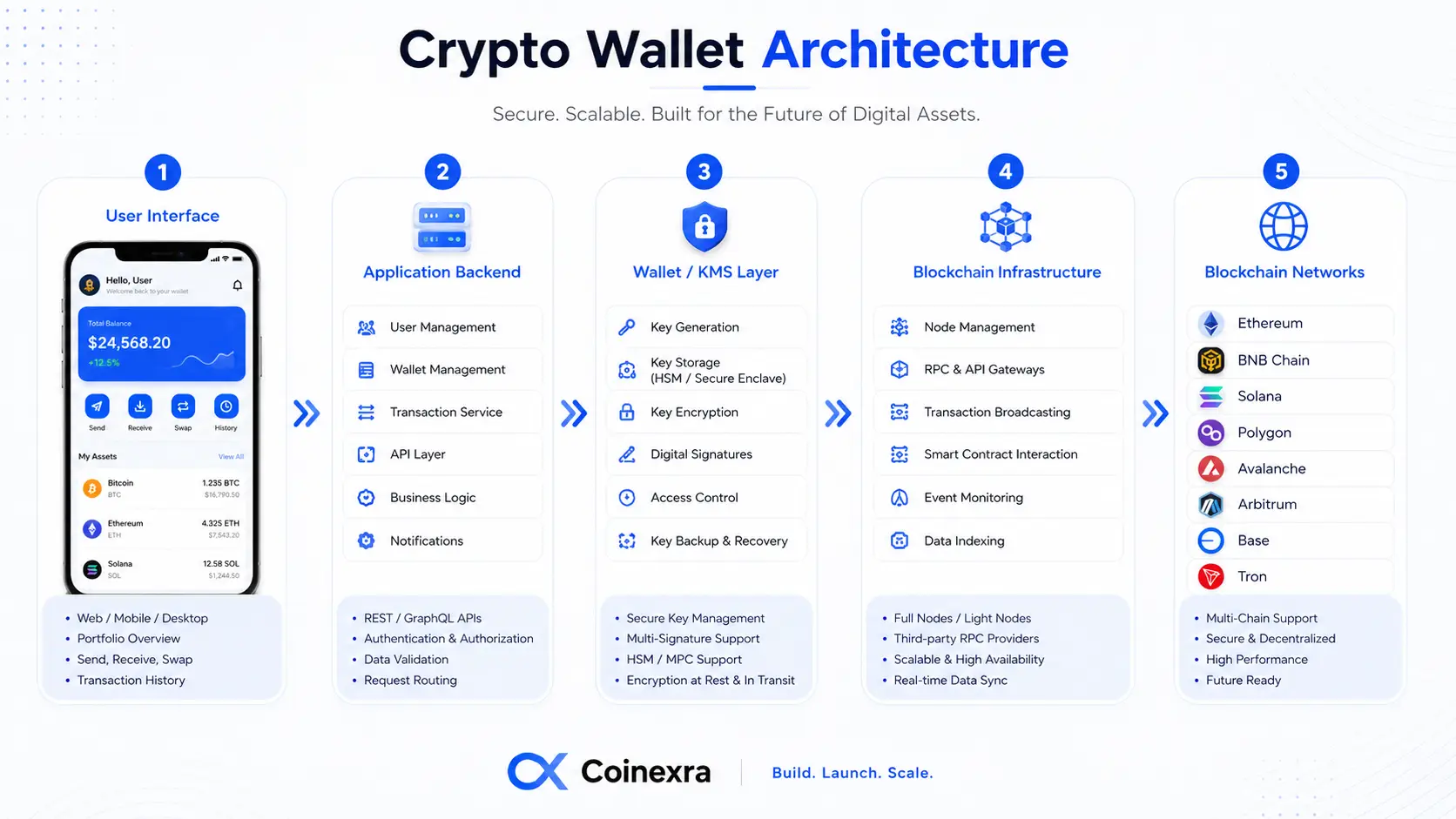
As shown in the architecture above, each layer has a specific role in connecting the user's wallet experience with the underlying blockchain networks.
Depending on the wallet model, additional components may include:
- Authentication service
- Key management system
- Transaction service
- Blockchain node or RPC provider
- Database
- Notification service
- Analytics
- Compliance integrations
- Swap provider
- Fiat on-ramp
- Admin dashboard
For a non-custodial wallet, private key management requires particular attention because sensitive key material should not be exposed unnecessarily to backend systems.
Step 5: Build Secure Wallet and Key Management
Private keys and seed phrases are among the most sensitive components of a cryptocurrency wallet. The wallet architecture should therefore implement appropriate protections for key generation, storage, backup, recovery, and transaction signing.
Depending on the wallet architecture, security mechanisms can include:
- Secure key generation
- Encrypted key storage
- Hardware-backed security where available
- Secure enclave or keystore mechanisms
- Seed phrase protection
- Biometric authentication
- PIN or password protection
- Transaction confirmation
- Secure backup mechanisms
- Session controls
- Device security checks
For custodial systems, businesses may also evaluate technologies such as HSMs and dedicated key management infrastructure. Security should be designed into the architecture from the beginning rather than added after development.
Step 6: Develop the Core Wallet Features
Once the wallet architecture, blockchain networks, and key-management foundation are in place, the next stage is to develop the core functionality users will rely on to manage and transact with digital assets. These are all the essential features that need to be included:
Wallet Creation
Users should be able to create or import wallets securely, with the appropriate key-generation, backup, and recovery mechanisms based on the architecture.
Send and Receive
Users should be able to send and receive supported assets using blockchain addresses or QR codes. The transaction flow should be clear, with confirmation requirements before a transaction is authorized.
Asset Management
The wallet should display supported assets, balances, and transaction information in a clear and accessible interface.
Transaction History
Users should be able to view transaction status, timestamps, amounts, network fees, and blockchain references to manage the history of transactions.
Network Management
Multi-chain wallets should provide an intuitive way to switch between supported networks while helping users select the correct network for each transaction.
Address Management
Users may need address books, address validation, QR codes, and transaction confirmation mechanisms. These controls can help reduce input errors and provide a more consistent transaction experience.
Step 7: Add Advanced Wallet Features
Once the core wallet functionality is complete, advanced capabilities can be added based on the business model. These features can extend the wallet beyond basic asset management and introduce additional ways for users to interact with digital assets.
Token Swap
Integrate decentralized or third-party swap infrastructure to allow users to exchange supported assets without leaving the wallet interface.
Staking
Enable users to participate in supported staking mechanisms directly through the wallet, depending on the supported networks and staking model.
NFT Management
Allow users to view and manage compatible NFTs alongside their other assets. NFT support may include displaying collections and ownership information.
dApp Connectivity
Enable users to connect the wallet with decentralized applications and authorize supported blockchain transactions.
Fiat On-Ramp
Integrate payment providers so users can purchase supported crypto assets using fiat currencies.
Portfolio Tracking
A well-designed portfolio view can help users understand their overall digital asset position without manually checking individual wallets.
Step 8: Develop the Admin Dashboard
A crypto wallet business also needs administrative infrastructure to manage the platform, monitor wallet activity, and oversee day-to-day operations, the admin dashboard acts as the operational control layer.
The admin dashboard can provide capabilities such as:
- User management
- Wallet monitoring
- Asset management
- Blockchain network configuration
- Transaction monitoring
- Fee configuration
- Security monitoring
- Support management
- Analytics
- Reporting
- Role-based access control
Administrative access should use strong authentication and appropriate authorization controls because a compromised admin account can create significant security risks.
Step 9: Integrate Blockchain Infrastructure
The wallet needs reliable communication with the supported blockchain networks to retrieve balances, monitor transactions, and track confirmations. The infrastructure layer acts as the connection between the wallet application and the underlying blockchain networks.
Depending on the architecture, this can involve:
- Running blockchain nodes
- Using RPC providers
- Blockchain APIs
- Indexing services
- Transaction broadcasting infrastructure
- WebSocket connections
The right infrastructure approach should be designed to handle transaction requests, blockchain confirmations, balance updates, network failures, and temporary service interruptions.
Step 10: Implement Crypto Wallet Security
Security is one of the most important stages of crypto wallet development. A wallet can potentially manage assets with significant monetary value, making it a high-value target for attackers.
Security measures can include:
- Encryption at rest and in transit
- Secure authentication
- Multi-factor authentication
- Biometric authentication
- Rate limiting
- Device binding
- Session management
- Secure key storage
- Transaction signing controls
- Address validation
- Anti-phishing protections
- Role-based access control
- Security logging
- Continuous monitoring
- Vulnerability testing
For applications handling sensitive assets, security testing should cover both the application layer and blockchain transaction logic. Security should be designed into the architecture from the beginning rather than added later.
Step 11: Test the Crypto Wallet
Before deployment, the wallet should go through extensive testing to verify that its core functionality, blockchain interactions, and performance are reliable under expected and unexpected conditions.
Functional Testing
Verify that wallet features work according to requirements, including wallet creation, asset management, sending and receiving transactions, and transaction history.
Security Testing
Identify vulnerabilities in authentication, APIs, key management, transaction flows, and application infrastructure.
Blockchain Testing
Test transaction creation, signing, broadcasting, confirmation, failed transactions, and network changes.
Performance Testing
Determine whether the infrastructure can handle expected user and transaction volumes while maintaining acceptable response time.
Compatibility Testing
Verify that the wallet operates correctly across supported devices, operating systems, browsers, and blockchain environments where applicable.
Smart Contract Testing
If the wallet interacts with smart contracts, contracts and transaction flows should be thoroughly tested and independently reviewed where appropriate.
Step 12: Deploy the Crypto Wallet
Once the wallet has completed functioning after testing, the next stage is deploying it to the production environment. Deployment should be treated as a controlled release process rather than simply making the application publicly accessible.
A typical production environment may use cloud infrastructure combined with:
- Load balancing
- Containers
- Monitoring
- Logging
- Automated deployment
- Database backups
- Security controls
- Disaster recovery
- Scalable blockchain infrastructure
The production architecture should be designed around expected user volume, transaction throughput, supported networks, and security requirements.
Step 13: Monitor and Maintain the Wallet
Launching the crypto wallet is not the end of the development process. Once the wallet is live, continuous monitoring and maintenance are required to keep the platform secure, reliable, and aligned with business requirements.
Ongoing activities can include:
- Security monitoring
- Dependency updates
- Blockchain network upgrades
- Performance optimization
- Bug fixes
- New blockchain integrations
- Feature enhancements
- Infrastructure scaling
- Security audits
- Compliance updates
Regular maintenance also provides an opportunity to improve the wallet based on user feedback, introduce new supported networks or assets, and expand functionality as the product evolves.
Essential Features of a Crypto Wallet
The essential features of a crypto wallet depend on many factors. However, a well-designed wallet should provide a reliable foundation for managing assets and protecting users throughout the transaction lifecycle.
| Feature | Purpose |
| Wallet Creation | Allows users to create wallets securely |
| Send & Receive | Enables blockchain transactions |
| Multi-Chain Support | Supports assets across multiple networks |
| Token Management | Allows users to manage supported assets |
| Transaction History | Tracks wallet activity |
| Token Swap | Enables asset exchanges |
| dApp Connectivity | Connects users to Web3 applications |
| NFT Management | Allows users to manage NFTs |
| Staking | Supports eligible staking opportunities |
| Fiat On-Ramp | Enables crypto purchases through supported providers |
| Portfolio Tracking | Provides an overview of asset holdings |
| Push Notifications | Keeps users informed about wallet activity |
| Security Controls | Protects accounts and transactions |
| Admin Dashboard | Enables platform management and monitoring |
Technology Stack for Crypto Wallet Development
The technology stack depends on the wallet type, supported blockchains, platforms, and security architecture. A typical technology stack may include:
Frontend: React.js, Next.js
Mobile: React Native, Flutter
Backend: Node.js, Java, Python
Database: PostgreSQL, MongoDB
Blockchain: Ethereum, BNB Chain, Solana, Polygon, Tron, others
Smart Contracts: Solidity, Rust
APIs: REST APIs, WebSocket
Infrastructure: AWS, Google Cloud, Docker, Kubernetes
Security: Encryption, MFA, HSM/KMS, where applicable
The tech stack should be selected based on the architecture, rather than following a fixed technology combination, each layer should be selected according to the wallet's functional and infrastructure requirements.
How Much Does It Cost to Create a Crypto Wallet?
The cost of creating a crypto wallet depends heavily on its functionality, blockchain support, security architecture, platform, integrations, and development approach.
As a rough illustrative estimate, a basic white label crypto wallet may require an initial budget of around $15,000 - $20,000, but a custom build and more advanced multi-chain wallet can range from approximately $50,000 - $150,000+ depending on its functionality, security requirements, integrations, and platform coverage.
Major cost factors include:
- Wallet type
- Number of blockchain networks
- Number of supported assets
- Mobile and web platforms
- Custodial or non-custodial architecture
- Key management infrastructure
- Security requirements
- Backend architecture
- Third-party integrations
- Admin dashboard
- Testing and security audits
- Compliance requirements
- Post-launch maintenance
A white label crypto wallet generally requires less initial development effort because core infrastructure and functionality already exist.
Building from scratch typically requires a larger investment because your development team must design, develop, test, secure, and maintain the underlying infrastructure. Choosing the right option depends on whether your priority is speed to market, customization, technical ownership, or long-term product control.
How Long Does It Take to Build a Crypto Wallet?
The development timeline depends on the wallet's scope. A basic white label crypto wallet can be launched in around 2 - 6 weeks, while a custom-built wallet can take approximately 4 - 9 months+, depending on its functionality, security requirements, integrations, testing, and platform coverage.
The timeline is influenced by:
- Number of platforms
- Blockchain networks
- Wallet architecture
- Feature complexity
- Security requirements
- Third-party integrations
- Testing requirements
- Compliance requirements
A white label solution can typically be launched faster because the core infrastructure already exists. Custom crypto wallet development requires additional time due to its custom architecture, development, testing, and post-launch optimization.
How Do Crypto Wallets Make Money?
A crypto wallet can generate revenue through several business models. The right monetization model depends on the wallet's target users, supported assets, geographic markets, and overall business strategy. Here are some of the commonly used revenue models:
Transaction Fees
Charge a fee on eligible wallet transactions, such as transfers or other supported blockchain operations.
Swap Fees
Generate revenue from cryptocurrency swaps conducted through the wallet, either through platform fees or applicable revenue-sharing arrangements.
Staking Fees
Charge service or platform fees for supported staking services where the wallet enables users to participate in staking.
Premium Subscriptions
Offer advanced wallet functionality through paid plans, such as enhanced portfolio tools, additional features, or other premium capabilities.
Fiat On-Ramp Commissions
Generate revenue through partnerships with payment and fiat on-ramp providers when users purchase supported crypto assets using traditional currencies.
Partner Commissions
Earn commissions through integrations with relevant third-party crypto services that users can access through the wallet.
DeFi Services
Generate revenue through selected DeFi-related integrations, depending on the wallet's ecosystem and business model.
NFT Services
Monetize NFT-related features, transactions, or marketplace integrations where these capabilities are relevant to the target audience.
A wallet does not necessarily need to implement every revenue model from the beginning. The most appropriate approach is to prioritize monetization methods that align naturally with the wallet's core functionality and user activity, then expand the revenue model later. With a plug-and-play white-label crypto wallet, a business can expand the revenue model without affecting platform performance.
Common Mistakes to Avoid When Creating a Crypto Wallet
Building a crypto wallet involves decisions across product strategy, blockchain infrastructure, and security. So carefully evaluating these areas can create avoidable technical or business challenges after launch.
Treating Security as an Afterthought
Security should be considered during architecture and development rather than added immediately before launch.
Supporting Too Many Blockchains Initially
Adding multiple networks increases development and maintenance complexity. Start with networks that matter to your target users.
Ignoring User Experience
Crypto transactions can already be complicated for beginners. The wallet interface should make addresses, networks, fees, confirmations, and transaction status easy to understand.
Depending Entirely on One Infrastructure Provider
Consider redundancy and fallback mechanisms where appropriate to reduce dependency on a single external service.
Launching Without Comprehensive Testing
A wallet handling digital assets should undergo extensive functional, security, and performance testing before production deployment.
Building Every Feature at Once
A focused initial feature set can make it easier to validate user demand, identify technical issues, and improve the product before expanding its functionality.
White Label or From Scratch: Which Crypto Wallet Development Approach Is Right for You?
Choosing between a white label crypto wallet and building a wallet from scratch depends on your product goals and launch timeline. Both approaches can support a successful crypto wallet, but they also come with different trade-offs as well.
Choose a white label crypto wallet if you:
- Want to launch quickly
- Have a limited initial development team
- Want to reduce development effort
- Need proven core wallet functionality
- Want to validate your business model
- Prefer to focus on branding and customer acquisition
Choose custom crypto wallet development if you:
- Need complete control over the architecture
- Require highly customized functionality
- Have unique security requirements
- Want proprietary wallet infrastructure
- Plan to build a long-term crypto ecosystem
- Need deep integrations with your existing platform
There is also a third practical approach: start with a white label wallet and progressively customize or expand the product as your business grows, provided the chosen infrastructure supports the required level of customization and ownership.
Why Choose Coinexra for Starting Your Crypto Wallet Business?
Coinexra provides a ready-to-launch white-label crypto wallet designed for businesses that want to enter or expand in the digital asset market. Instead of forcing every business into the same wallet architecture, Coinexra can support different requirements with faster white-label crypto wallet deployment.
Our wallet solutions can be tailored around requirements such as:
- Multi-chain wallet support
- Multi-asset management
- Token swaps
- Staking
- NFT management
- dApp connectivity
- Portfolio tracking
- Transaction management
- Security controls
- Admin management
- API integrations
Coinexra's white label solutions can help reduce the initial development effort and provide a more direct path from product planning to launch. Businesses can use the existing wallet infrastructure as a foundation while adapting the product experience and functionality to their specific requirements.
Whether you are launching a new crypto wallet or building a broader digital asset ecosystem, the development approach can be selected according to your product requirements and timeline.
Frequently Asked Questions
How do I create a crypto wallet?
You can create a crypto wallet using either a white label wallet solution or by developing one from scratch. The process generally involves defining the wallet model, selecting supported blockchains, designing the architecture, implementing key management and security, developing core features, integrating blockchain infrastructure, testing, deploying, and maintaining the wallet.
How much does it cost to create a crypto wallet?
Crypto wallet development costs vary based on features, blockchain networks, platforms, security requirements, integrations, and development approach. A white label solution generally costs you around $15,000 - $20,000 because it requires less initial development effort, while a wallet built from scratch requires $50,000 - $100,000 based on architecture, development, testing, and maintenance.
How long does it take to build a crypto wallet?
The timeline depends on the wallet's complexity. A white label wallet can generally be launched in 4 - 6 weeks, which is way faster than a fully custom wallet because core infrastructure is already available. But a custom multi-chain wallet requires 5 - 9 months for development, testing, security, and deployment.
Is it better to build a crypto wallet from scratch or use white label software?
Neither approach is universally better. White label software is generally more suitable for businesses prioritizing faster deployment and reduced development effort. Building from scratch is more suitable when extensive customization, technical control, and proprietary infrastructure are important.
Can I create a multi-chain crypto wallet?
Yes. A multi-chain crypto wallet can support multiple blockchain networks, provided the wallet architecture and blockchain infrastructure are designed to handle the technical differences between networks.
Can I monetize a crypto wallet?
Yes. Common wallet revenue models include transaction fees, swap fees, staking fees, premium subscriptions, partner commissions, fiat on-ramp commissions, and selected DeFi or NFT services.
Is a crypto wallet legal to operate?
The regulatory requirements depend on the wallet's functionality, custody model, services offered, and jurisdictions in which the business operates. Businesses should obtain appropriate legal and compliance advice before launching a crypto wallet.
Can I launch a crypto wallet under my own brand?
Yes. A white label crypto wallet can be customized with your business branding and configured around supported assets, networks, features, and integrations, depending on the capabilities of the chosen solution.
Final Thoughts
Creating a crypto wallet is no longer limited to building a basic application for storing and transferring digital assets. Modern crypto wallets can become complete digital asset platforms supporting multiple blockchains.
For businesses, the first major decision is whether to use white label crypto wallet software or build a wallet from scratch.
A white label crypto wallet solution can help businesses reduce development effort and enter the market faster, while custom development provides greater control over architecture, features, security, and long-term product direction.
The best approach depends on your budget, timeline, technical requirements, target users, and business objectives.
If you are planning to launch a crypto wallet, Coinexra’s experts can help you identify the wallet architecture, features, blockchain networks, and deployment model that fit your business requirements.