

It is no surprise that cryptocurrency exchanges are among the most important businesses in the digital asset ecosystem. They provide users with a platform to buy, sell, swap, trade, and manage cryptocurrencies while generating revenue from a plethora of services.
But how do crypto exchanges make money?
The primary revenue source is usually trading fees, but successful crypto exchanges seldom depend on a single income stream. They generate revenue through withdrawal fees, deposit fees, spread-based pricing, listing fees, staking services, lending, premium subscriptions, institutional services, fiat on-ramp and off-ramp services, and other value-added products.
For entrepreneurs planning to launch a cryptocurrency exchange, understanding these revenue models is essential to building a sustainable and profitable crypto exchange business.
In this guide, we explore 10 proven ways crypto exchanges make money, how each model works, and how you can build a profitable cryptocurrency exchange business.
How Do Crypto Exchanges Make Money?
Crypto exchanges make money by charging users and businesses fees for trading, transactions, withdrawals, listings, and additional financial services.
The most common crypto exchange revenue streams include:
| Revenue Model | How It Generates Revenue |
| Trading Fees | Charges a fee on cryptocurrency trades |
| Withdrawal Fees | Charges users when they withdraw assets |
| Deposit Fees | Charges for certain deposit methods |
| Spread Revenue | Earns from the difference between buy and sell prices |
| Listing Fees | Charges projects to list tokens |
| Staking Fees | Takes a percentage from staking rewards |
| Lending Revenue | Earns interest or service fees from crypto lending |
| Premium Subscriptions | Charges for advanced features and benefits |
| Institutional Services | Generates revenue from professional trading services |
| Fiat On/Off-Ramp Fees | Earns fees from crypto-to-fiat transactions |
Among these, trading fees and spread revenue are generally the most fundamental exchange revenue sources, while additional services can diversify income and increase customer lifetime value.

Now, let's examine each model in detail.
1. Trading Fees
Trading fees are one of the most common ways cryptocurrency exchanges generate revenue.
Whenever a user buys or sells a digital asset, the exchange levies a small percentage of the transaction value. The exact fee structure is subjective and varies depending on the exchange, trading volume, user tier, and type of transaction.
For example, an exchange could charge:
- 0.10% maker fee
- 0.20% taker fee
If a user executes a trade worth $10,000 at a 0.20% fee, the exchange would generate $20 in revenue from that transaction.
This is not to be underestimated; at scale, even relatively small trading fees can generate substantial revenue.
Maker and Taker Fees
Many exchanges use a maker-taker fee model.
Maker fees apply when users add liquidity to the order book by placing orders that are not immediately matched.
Taker fees apply when users execute existing orders from the order book.
Exchanges may offer lower fees to high-volume traders to encourage greater trading activity.
Why Trading Fees Matter
Trading fees are attractive because they directly scale with platform activity. More users, higher trading volume, and greater transaction frequency can increase exchange revenue.
But keep in mind, exchanges need to balance fees carefully. Excessively high trading fees have been known to discourage active traders and push them toward competitors.
2. Withdrawal Fees
Crypto exchanges can also generate revenue by charging users whenever they withdraw cryptocurrencies from the platform.
A withdrawal fee may be structured as:
- A fixed fee
- A percentage of the withdrawal
- A network fee plus a service fee
- A dynamic fee based on blockchain conditions
For example, an exchange may charge a small service fee when a user withdraws Bitcoin, Ethereum, or another cryptocurrency to an external wallet.
The actual blockchain network fee and the exchange's service charge should be clearly distinguished to users.
Are Withdrawal Fees Profitable?
Withdrawal fees can provide an additional revenue stream, but exchanges need to keep an eye out to remain competitive. If withdrawal fees are higher than competitors or actual network costs, users may become dissatisfied.
A transparent fee structure can help maintain trust while still generating revenue.
3. Spread-Based Revenue
Another way crypto exchanges make money is through spreads.
The spread is the difference between the price at which an exchange sells an asset and the price at which it buys the asset.
For example:
- Buy price: $60,000
- Sell price: $60,300
- Spread: $300
Depending on the exchange's business model, this price difference can contribute to revenue.
Spread-based pricing is particularly common in broker-style cryptocurrency platforms and instant-buy or instant-swap services.
Trading Fees vs. Spreads
A traditional exchange may display a clearly defined trading fee. A broker-style platform may instead incorporate its revenue into the quoted exchange rate.
Both approaches can work, but businesses should clearly communicate pricing to avoid creating confusion for users.
4. Crypto Listing Fees
Token listing fees are yet another revenue source for cryptocurrency exchanges.
Focused on new blockchain projects that often want their tokens to be visible to a larger audience, here comes Crypto listing and you can charge crypto listing fees for it. Exchanges can charge projects for evaluating, integrating, and listing their assets.
A listing package may include services such as:
- Token integration
- Wallet integration
- Trading pair creation
- Technical integration
- Market support
- Marketing exposure
- Liquidity-related services
It is very critical for exchanges not to treat listing fees as a substitute for proper token due diligence.
A sustainable exchange should have a transparent listing process that considers technical security, project legitimacy, liquidity, regulatory requirements, and user protection.
5. Staking Fees
Staking is an important feature for exchanges supporting proof-of-stake blockchain networks.
Instead of having to require users to interact directly with blockchain validators, an exchange provides convenience and provide a simplified staking service. The exchange receives staking rewards from blockchain networks and retains a service fee before actually distributing further rewards to users.
For example:
User staking → Validator/network rewards → Exchange service fee → User receives remaining rewards
The exact economics are subject to the blockchain, validator arrangement, custody model, and exchange's fee structure.
Why Staking Is Attractive
Staking can provide exchanges with:
- Additional recurring revenue
- Higher user engagement
- Increased asset retention
- New financial products
- Greater customer lifetime value
Thereby encouraging users to have their digital assets within the ecosystem.
6. Crypto Lending and Borrowing
Some crypto platforms generate revenue by providing lending and borrowing services.
Users get to earn interest in a lending model by lending cryptos to other users on the existing platform. Borrowers may pay interest or service fees to access liquidity.
The exchange or platform can potentially earn revenue through:
- Interest spreads
- Origination fees
- Service fees
- Collateral management fees
For example:
Lenders provide assets → Platform facilitates lending → Borrowers pay interest → Platform earns a service margin
Crypto lending involves significant financial, operational, counterparty, liquidity, and regulatory risks. Businesses should be wary when considering this model, should design appropriate risk controls, and operate within applicable laws.
7. Premium Subscriptions
Another revenue stream would be from premium subscriptions with exemplary services. Instead of charging only transaction-based fees, an exchange can offer subscription plans with additional features.
A premium plan could include:
- Lower trading fees
- Advanced trading tools
- Higher transaction limits
- Premium market analytics
- Advanced portfolio tracking
- Priority customer support
- Exclusive research
- API access
- Enhanced account features
For example, an exchange could offer:
Basic: Free
Professional: $19/month
Institutional: Custom pricing
This stream is a popular and more predictable revenue stream that doesn't have to rely entirely on trading volume.
8. Institutional Trading Services
Professional traders, hedge funds, family offices, market makers, fintech companies, and other businesses typically generate substantial trading volume, and crypto exchanges can create dedicated institutional products to serve this customer base.
Potential revenue sources include:
- Institutional trading fees
- OTC trading fees
- API access
- Custody services
- Dedicated account management
- Liquidity services
- Custom settlement solutions
- Institutional analytics
Institutional customers typically expect higher performance, liquidity, security, compliance, and support standards than what regular retail users use, and building these features brings a higher-value revenue segment for an exchange.
9. Fiat On-Ramp and Off-Ramp Fees
There is an unavoidable constant shuttle between traditional currencies and digital assets; exchanges can provide on-ramp and off-ramp services. An exchange can generate revenue by facilitating:
Fiat → Cryptocurrency
and
Cryptocurrency → Fiat
For example, users may purchase Bitcoin using:
- Bank transfers
- Credit cards
- Debit cards
- Payment providers
- Local payment methods
The exchange can charge transaction or service fees depending on the payment method and business model.
Fiat infrastructure can also enhance an exchange's overall usability by making it easier for rookies to enter and exit the crypto market.
10. Additional Financial and Ecosystem Services
Once an exchange has established a significant user base that is well supported, it can expand into additional products and services.
Potential monetization opportunities include:
- Crypto payment services
- Token launch platforms
- NFT marketplaces
- Copy trading
- Trading bots
- Derivatives
- Margin trading
- Crypto cards
- Merchant services
- Portfolio management
- API services
- Research and analytics
- Advertising and sponsored placements
Adding many products is easy, but there is no point if it doesn't address any pain point.
Instead, exchanges should identify services that complement their target audience and increase revenue per user whilst also maintaining strong risk management and regulatory compliance that actually builds trust and reputation in the long run.
Crypto Exchange Revenue Model: How Much Can an Exchange Make?
Subjective. There is no fixed amount that a cryptocurrency exchange can earn.
But rather revenue depends on vital factors such as:
- Number of active users
- Daily trading volume
- Trading fee percentage
- Average transaction size
- Withdrawal volume
- Spread
- Number of listed assets
- Staking activity
- Subscription adoption
- Institutional trading volume
- Geographic market
- Product offering
- Customer acquisition costs
A simplified trading-fee calculation can help illustrate the model.
Example
Let's say an exchange processes:
$50 million in monthly trading volume
and generates an average effective trading fee of:
0.15%
Estimated trading-fee revenue:
$50,000,000 × 0.15% = $75,000 per month
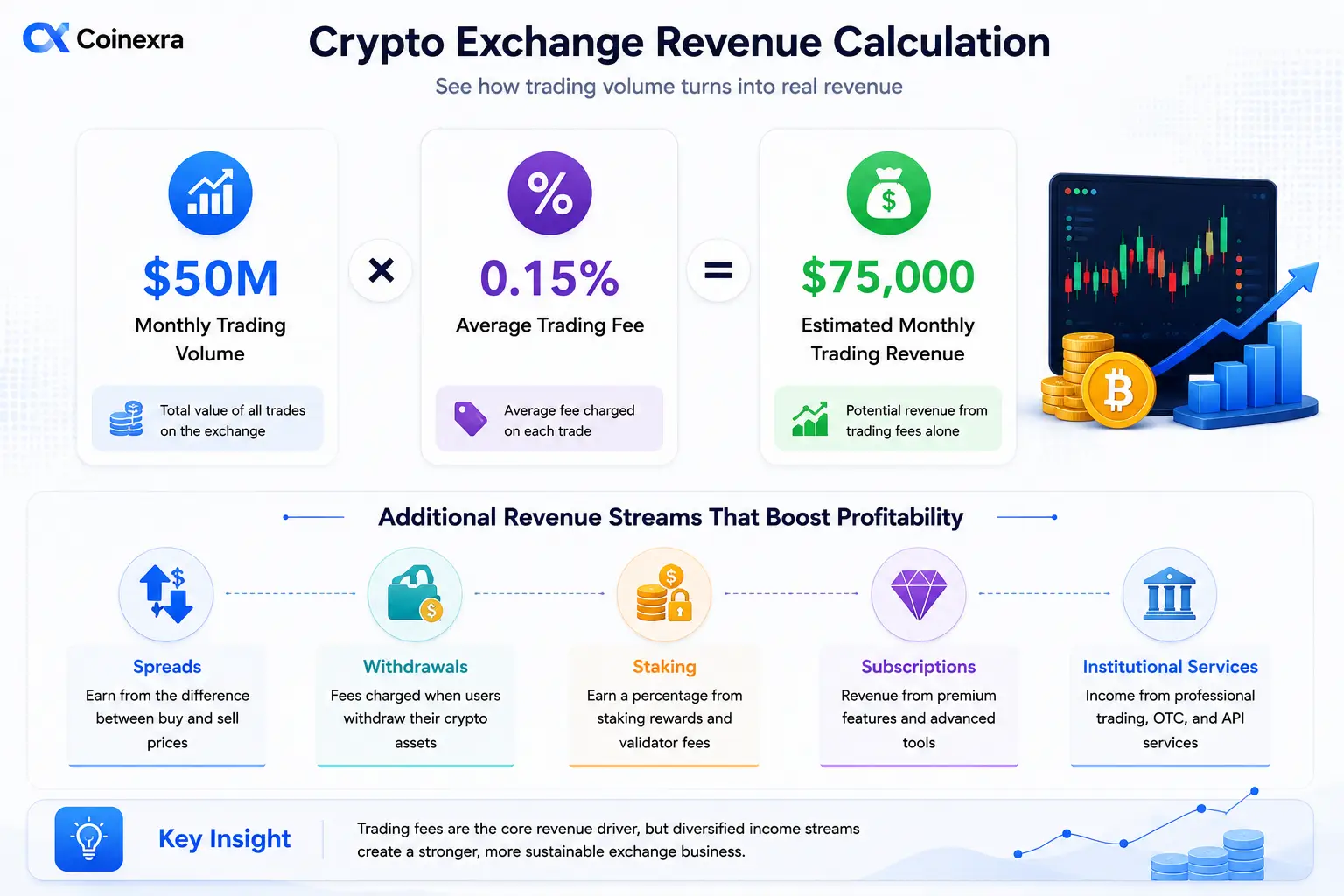
This is only an illustrative calculation. Actual exchange revenue depends on the fee structure, discounts, rebates, liquidity arrangements, product mix, and operating costs.
Additional revenue from spreads, withdrawals, subscriptions, staking, institutional services, and other products could increase or decrease the total revenue.
Crypto Exchange Revenue vs. Profit: What's the Difference?
A common mistake when evaluating an exchange business is to treat revenue as profit.
They are not the same.
An exchange can generate significant transaction revenue while still having substantial operating expenses.
Major crypto exchange costs can include:
- Technology development
- Cloud infrastructure
- Blockchain node infrastructure
- Security systems
- Compliance
- Licensing
- Legal services
- Liquidity
- Market making
- Payment processing
- Customer support
- Marketing
- Employee salaries
- Insurance and risk management
Therefore, a successful crypto exchange needs to optimize both revenue generation and operating efficiency.
What Is the Most Profitable Crypto Exchange Revenue Model?
There is no universal "most profitable" model because profitability depends purely on the exchange's target market, trading volume, fee structure, costs, liquidity, and regulatory environment.
Nevertheless, trading fees are typically the core monetization mechanism for many exchanges because they scale directly with transaction volume.
A diversified exchange can combine multiple revenue streams:
Trading Fees + Spreads + Withdrawal Fees + Staking + Subscriptions + Institutional Services + Fiat Services
This approach reduces dependence on a single source of income.
How Coinexra Helps Businesses Launch Crypto Exchanges
Coinexra provides ready-to-launch white-label crypto exchange software designed for businesses that want to launch and operate their own branded cryptocurrency exchange but without the long development cycle, energy, and monetary resources needed to build it from scratch.
Our solution can be customized around your business model, supported assets, trading requirements, branding, and target market, delivering the quality of a product built from the ground up.
Businesses can leverage the market with a pre-built infrastructure while creating their own exchange brand and monetization strategy.
Coinexra’s White Label Crypto Exchange Includes
- Custom exchange branding
- Advanced trading functionality
- Crypto wallet infrastructure
- Multi-chain support
- Liquidity integration
- Trading pairs
- Admin management
- User management
- Security controls
- KYC and AML integration support
- API integration
- Customizable fee structures
- Scalable infrastructure
Whether you are launching a new crypto exchange or expanding an existing fintech business, Coinexra can help you move from concept to a market-ready exchange platform. Teaming up with us gives you the best tech and an expert team that provides ongoing support.
Ready to launch your own crypto exchange? Explore Coinexra's White-Label Crypto Exchange solution to build a revenue-focused digital asset trading platform.
Frequently Asked Questions
How do crypto exchanges make money?
Crypto exchanges primarily make money through trading fees. They can also generate revenue through spreads, withdrawal fees, listing services, staking, lending, subscriptions, institutional services, fiat on-ramp and off-ramp fees, and other financial products.
What is the main source of crypto exchange revenue?
Trading fees are one of the most common primary revenue sources for cryptocurrency exchanges. The exchange earns a fee when users execute buy or sell transactions.
Do crypto exchanges make money from withdrawals?
Yes. Some exchanges charge withdrawal fees when users transfer cryptocurrency from their platform to an external wallet. The fee structure varies between exchanges and assets.
How do decentralized exchanges make money?
Decentralized exchanges can generate revenue through trading fees, protocol fees, liquidity-related mechanisms, token-related services, and other ecosystem products. The exact model depends on the protocol's design and governance structure.
How much does it cost to start a crypto exchange?
The cost varies significantly depending on the exchange model, features, number of supported assets, security requirements, liquidity, integrations, compliance requirements, mobile applications, and level of customization.
A white-label solution can generally reduce the development effort compared with building an exchange entirely from scratch.
Can I start a crypto exchange using white-label software?
Yes. A white-label crypto exchange allows businesses to use pre-built exchange infrastructure, customize the platform with their branding and business requirements, and launch more quickly than developing the entire technology stack independently.
Is a crypto exchange profitable?
A crypto exchange can be profitable, but profitability depends on trading volume, fee structure, liquidity costs, customer acquisition, technology expenses, compliance, security, and other operating costs. A diversified revenue model can help reduce dependence on trading fees alone.
What are the best crypto exchange revenue models?
Trading fees, spreads, withdrawal fees, staking, subscriptions, institutional services, and fiat on-ramp/off-ramp services are among the major monetization models. The best combination depends on the exchange's target market and business strategy.
End Note
Understanding how crypto exchanges make money is essential for anyone planning to enter the digital asset industry.
Trading fees may form the foundation of an exchange's revenue, but the strongest business models often combine multiple monetization channels. Spreads, withdrawals, staking, subscriptions, institutional services, fiat transactions, and additional financial products can create diversified revenue opportunities.
There is no point in simply launching a crypto exchange; rather, build an exchange with a clear target market, a competitive fee structure, strong liquidity, robust security, a regulatory strategy, and a sustainable revenue model.
If speed to market is a priority, a white-label crypto exchange can provide a practical alternative to developing the entire platform from scratch.
Partner with Coinexra to launch a branded cryptocurrency exchange with customizable, ready-to-deploy exchange infrastructure.