
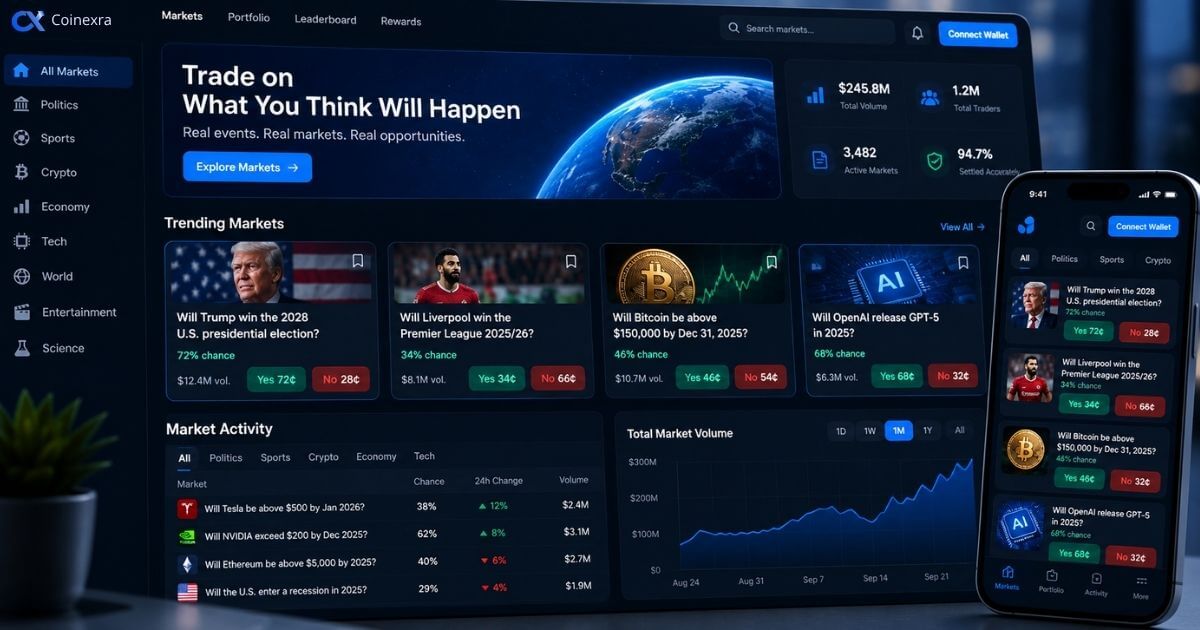
Prediction markets allow users to take positions on the outcomes of future events, including elections, sports, financial events, cryptocurrency movements, and entertainment. However, there is no fixed prediction market platform cost, as the budget depends on the solution you choose, the level of customization, trading model, settlement process, infrastructure, regulatory scope, and expected scale.
For businesses that want to enter the market without creating everything from scratch, a white-label prediction market platform offers an existing foundation that can be branded and customized. So, how much does it cost to build a prediction market platform? A practical range can start at around $10,000 for a basic white-label setup and go beyond $350,000 for a highly customized enterprise solution, depending on the scope and requirements.
Prediction Market Platform Cost Breakdown 2026
The most useful way to understand prediction market platform costs is to look at the launch approach first.
| Platform Approach | Estimated Cost | Typical Launch Scope |
| Basic White Label | $10,000–$25,000+ | Existing platform, branding, configuration, and launch setup |
| Customized White Label | $25,000–$60,000+ | Existing infrastructure with deeper customization |
| Custom MVP | $30,000–$80,000+ | Purpose-built platform with a focused initial scope |
| Advanced Custom Platform | $80,000–$200,000+ | More complex trading, settlement and infrastructure requirements |
| Enterprise Platform | $150,000–$350,000+ | Large-scale, highly customized deployment |
The aforementioned figures are to be considered as standard and not the ultimate fixed market price. White label implementations are generally positioned below heavily customized or exchange-grade solutions, although the exact scope included in each quote can differ substantially between providers.
A common mistake is that businesses usually compare the software price alone, but that is not the case.
A realistic launch budget also includes:
- Platform setup or licensing
- Branding and customization
- Hosting and infrastructure
- Data and oracle services
- KYC and AML services
- Payment-related expenses
- Security testing and audits
- Legal and regulatory preparation
- Liquidity
- Ongoing maintenance and support
A platform priced at a lower starting price might necessitate higher spending costs in the long run; therefore, superficial pricing should not be viewed alone. Current white label pricing models in the market show substantial differences in how vendors package setup, deployment, support, and operational costs.
Complete Cost of Starting a Prediction Market Platform in 2026
Rather than assigning one generic figure to every prediction market business, it is more useful to look at the kind of platform you are planning to launch.
Basic White Label Prediction Market Platform
Cost Range: $10,000–$25,000+
An apt choice for those wanting to enter the prediction market space using existing infrastructure with limited customization. The main objective at this level is to get a branded platform ready for launch without spending heavily on creating or restructuring the underlying system.
The budget may cover:
- Core platform setup
- Brand implementation
- Basic interface customization
- Market configuration
- Administrative setup
- Initial deployment
- Standard launch support
A perfect choice for businesses that already have a clearly defined concept and want to test the waters before making a larger infrastructural commitment.
The important consideration here is what the provider considers “white label.” Some solutions include a ready-to-use environment, while others may still charge separately for deployment, dedicated hosting, additional customization, or third-party services.
Customized White Label Prediction Market Platform
Cost range: $25,000–$60,000+
A customized white-label prediction market solution will fit like a glove if your business objective is to leverage a fast market entry with a solution that is highly modified to fit your business objectives and doesn’t feel like a template.
The additional budget can go toward business-specific requirements such as:
- Deeper UI and UX customization
- Custom user journeys
- Market management workflows
- Administrative changes
- Branding across web and mobile experiences
- Custom settlement requirements
- Additional payment or verification requirements
- Deployment changes
This approach often makes sense when a business already knows what its platform should look and operate like, but does not need to create the entire infrastructure independently. It also allows more of the launch budget to remain focused on the business itself, including compliance, liquidity, user acquisition, and market operations.
Custom Prediction Market MVP
Cost Range: $30,000–$80,000+
A custom MVP is a different proposition. Instead of starting with an established white-label product, the business commissions a platform around its own requirements. The purpose of an MVP is usually to establish the essential market experience without attempting to cover every possible requirement from day one.
The budget can increase based on:
- Custom trading logic
- User and account management requirements
- Market creation and resolution workflows
- Payment and wallet requirements
- Data handling
- Security requirements
- Deployment infrastructure
Businesses should beware of the future costs that accompany opting for a customized prediction market MVP.
Advanced Custom Prediction Market Platform
Cost range: $80,000–$200,000+
A solution for businesses that may need greater control over how markets are created, traded, priced, resolved, monitored, and settled. Infrastructure requirements also become more substantial as expected user activity and transaction volume increase.
Costs can rise because of:
- More complex market mechanics
- Advanced trading infrastructure
- Sophisticated settlement logic
- Blockchain or smart contract requirements
- Oracle and data infrastructure
- Stronger security controls
- Higher infrastructure capacity
- More extensive testing
This type of platform is typically planned around a clear long-term operating model rather than a simple proof of concept.
Enterprise Prediction Market Platform
Cost Range: $150,000–$350,000+
Businesses that may be planning for multiple markets, large user volumes, more demanding infrastructure, stricter operational controls, multiple jurisdictions, or deeper customization across the platform should opt for an enterprise prediction market platform
Costs can increase significantly because the platform may need:
- Dedicated infrastructure
- High-availability systems
- Advanced security and monitoring
- Disaster recovery planning
- Extensive compliance controls
- Custom market and settlement workflows
- Large-scale data processing
- Sophisticated administration
- Enterprise-level support
At this stage, businesses are paying for a platform that can support a more demanding operating environment while leaving room for continued customization and expansion.
What Factors Affect Prediction Market Platform Development Cost?
Not all prediction markets are the same; even if two separate prediction markets look similar superficially, beneath the facade, a different picture of budget, costs, and technology persists.
Development Approach
The starting approach has a major influence on the initial budget.
Businesses typically have three practical paths:
- White label: Start with an existing prediction market platform and configure it for the business.
- Customized white label: Use existing infrastructure while making bigger changes to the user experience and operating model.
- Custom-built: Create the platform specifically around the company's requirements.
White label solutions reduce the amount of foundational work because the core infrastructure is already available. A custom approach provides more control, but it also increases the amount of work involved in planning, testing, securing, deploying, and maintaining the platform.
Prediction Market Model
The trading mechanism itself can affect the complexity and cost of the platform.
Common approaches include:
- Order book or CLOB
- AMM
- Peer-to-peer
- Hybrid models
An order-book system needs efficient order creation, matching, pricing, and cancellation logic. An AMM requires liquidity pools and automated pricing mechanisms. A peer-to-peer system relies more heavily on participant matching, while a hybrid model can combine several forms of market infrastructure.
Because these models work differently, they can create different requirements for liquidity, settlement, pricing, and infrastructure.
Market Resolution Mechanism
Resolution is central to a prediction market.
Users are not simply buying an asset that already exists. They are taking a position on an outcome that has to be verified later. The platform therefore needs a reliable way to determine what happened and settle the market accordingly.
A typical resolution process needs to establish:
- What outcome the market represents
- When trading closes
- Which source determines the result
- How the result is verified
- When settlement occurs
- What happens if the outcome is delayed or disputed
A simple market with a clearly defined result can be easier to manage than one that depends on several data points, manual verification, or dispute handling.
Blockchain vs. Off-Chain Infrastructure
Blockchain is not automatically required for every prediction market.
A platform can operate using off-chain infrastructure, blockchain-based settlement, or a hybrid model depending on the business requirements.
Blockchain-based implementations can introduce additional expenses related to:
- Smart contracts
- Wallet connectivity
- On-chain settlement
- Network fees
- Oracle infrastructure
- Smart contract audits
- Multi-chain deployment
An off-chain model can simplify some of these requirements, while still requiring strong infrastructure for trading, settlement, account management, security, and transaction processing.
Data and Oracle Requirements
A prediction market needs reliable information to determine how an event develops and, ultimately, how it is resolved.
The data requirement can vary depending on the type of market being offered.
- Sports markets can depend on official event results.
- Financial markets can depend on defined prices or economic indicators.
- Political markets can depend on officially verified outcomes.
- Crypto markets can depend on market or blockchain data.
The platform needs a clear process for receiving the relevant information and determining when that information is sufficient to settle the market.
Liquidity Requirements
Liquidity deserves its own place in the budget because a prediction market cannot rely on software alone to create a functioning marketplace. Users need sufficient liquidity or opposing positions to enter and exit markets effectively.
Depending on the chosen model, the business may need to consider:
- Initial liquidity
- Market-making
- AMM liquidity
- Order-book depth
- Liquidity incentives
- Ongoing market participation
This is partly a technology issue, but it is also a business and operational issue. A platform can be technically ready for launch while still requiring meaningful liquidity planning to create an active trading environment.
Geographic and Regulatory Scope
The intended jurisdiction can influence both the platform configuration and the wider launch budget. Requirements can differ depending on where the business operates, which users it serves, how transactions are handled, and what kind of contracts or markets are offered.
Depending on the target market, businesses may need to consider:
- User eligibility
- KYC and AML requirements
- Licensing or authorization
- Restricted jurisdictions
- Market-specific restrictions
- Transaction monitoring
- Reporting obligations
- Data and privacy requirements
Security, Scalability and Infrastructure
A prediction market platform handles user accounts, market activity, transactions, settlement, and potentially financial value, so security and infrastructure requirements should be considered from the beginning.
Depending on the expected scale, the budget may need to cover:
- Application security
- Access controls
- Encryption
- Monitoring
- Backup systems
- Disaster recovery
- Security testing
- Penetration testing
There is a practical difference between infrastructure designed for an initial launch and infrastructure designed to support a large active user base.
Building only for today's requirements can create avoidable migration and scaling costs later, while overengineering the infrastructure before there is a clear need can make the initial launch unnecessarily expensive.
How Much Does a White Label Prediction Market Platform Cost?
A white label prediction market platform can generally start around $10,000 to $25,000+, while more customized implementations can move toward $25,000 to $60,000+ and beyond.
The cost is usually influenced by how much of the existing platform can be used without modification.
A basic implementation may focus primarily on getting the business operational under its own brand. A more customized deployment may require changes to the interface, user experience, market workflows, settlement process, administration, or supporting services.
Before comparing quotes, businesses should clarify:
- What is included in the base price
- What counts as customization
- Whether deployment is included
- Whether hosting is included
- Whether support is included
- Which third-party services are billed separately
- Whether there are recurring platform fees
- Whether additional development work is charged separately
What’s Included in White Label Prediction Market Software?
The exact package depends on the provider, but businesses should generally expect the following areas to be clearly identified before signing an agreement.
| Component | Usually Included | May Be Additional |
| Core Prediction Market | ✓ | |
| Trading Interface | ✓ | |
| Market Management | ✓ | |
| User Management | ✓ | |
| Admin Panel | ✓ | |
| Wallet Infrastructure | ✓ | |
| Market Resolution | Depends | ✓ |
| Data / Oracle Services | Depends | ✓ |
| KYC/AML Services | Depends | ✓ |
| Payment Integration | Depends | ✓ |
| Blockchain Integration | Depends | ✓ |
| Smart Contract Customization | ✓ | |
| Custom Mobile Apps | ✓ | |
| Additional Jurisdictions | ✓ | |
| Dedicated Infrastructure | Depends |
The distinction between “included” and “available” is important.
A provider may offer market resolution capabilities as part of its software, for example, while a business may still need additional configuration for its own resolution rules and data sources.
The same applies to KYC, payments, blockchain services, and other supporting components. Having the technical capability available does not necessarily mean that third-party service charges or custom configuration are included in the quoted price.
Before making a decision, businesses should ask for a clear scope that separates:
- Core software
- Configuration
- Customization
- Third-party services
- Deployment
- Recurring costs
- Post-launch support
That makes pricing easier to understand and prevents unexpected expenses from appearing after the agreement has been signed.
One-Time vs Ongoing Prediction Market Platform Costs
The initial platform price and the cost of keeping the platform operational are two different things. A business should account for both when planning its launch.
The balance between these two categories can vary considerably.
A white-label business may have a lower initial platform expense because it is starting from existing infrastructure, but it can still have meaningful recurring costs for hosting, data, compliance, support, liquidity, and third-party services.
On the other hand, a highly customized platform may carry a much larger initial investment while also requiring a larger ongoing technology and maintenance budget.
The key is to understand both sides before launch instead of treating the software acquisition price as the full cost of running the business.
How to Reduce Prediction Market Platform Costs
Cost control shouldn’t mean choosing the cheapest available software. It is often more effective to avoid spending money on requirements that are not necessary for the first stage of the business.
Start With a Focused Scope
A narrow, clearly defined launch can reduce unnecessary customization. The business can establish the core marketplace first and add additional capabilities as user demand and operating requirements arise.
Use Existing Infrastructure Where Practical
White-label software can remove a large amount of foundational work from the initial budget.
Rather than recreating core infrastructure, the business can use an existing platform and concentrate investment on branding, customization, compliance, liquidity, and market operations.
Customize the Parts That Matter
Not every part of the platform needs to be unique. Customization is usually most valuable where it directly affects:
- Brand identity
- User experience
- Business workflows
- Market operations
- Compliance requirements
- Revenue strategy
Launch in Phases
A phased rollout drastically reduces the pressure of trying to support every requirement from the beginning. Businesses can establish the core operation first and then introduce additional market types, interfaces, integrations, or infrastructure as the platform grows.
Plan Compliance Early
Regulatory and compliance requirements can influence platform selection, user flows, verification, payments, and market availability. Failure to address such requirements means they can snowball into bigger changes later on.
Avoid Overengineering
Infrastructure should be designed around realistic requirements. A startup launching with a smaller expected audience does not need the same infrastructure footprint as a large enterprise expecting significant traffic and trading activity.
Why Choose Coinexra’s White Label Prediction Market Platform?
Businesses that are looking forward to enter the prediction market business without having to take on the complete responsibility of building the underlying platform from the ground up, Coinexra’s White Label Prediction Market Platform provides an existing foundation that can be adapted to the business's brand and operating requirements.
Our White Label Approach lets you focus your resources on the parts of the launch that directly affect your market position whilst we breathe life into your core infrastructure.
Coinexra’s White Label Prediction Market solution can be customized around requirements such as:
- Platform branding
- Market management
- Trading workflows
- Settlement processes
- Business-specific configurations
- Infrastructure and scalability
- Integration requirements
- Post-launch support
We believe in delivering a solution that fits like a glove to your business requirements rather than a one-size-fits-all deliverable. The objective is not simply to provide software, but to give businesses a leveraged head start for launching their own prediction market under their own brand.
For businesses comparing the cost of creating everything independently with the cost of starting from an established foundation, a white label approach can provide a more practical route to market whilst leaving room for further customization as the business grows.
Frequently Asked Questions
How Much Does It Cost to Build a Prediction Market Platform?
A prediction market platform can cost from around $10,000 for a basic white label solution to $350,000+ for a highly customized enterprise platform.
How Much Does a White Label Prediction Market Platform Cost?
A basic white label prediction market platform can start around $10,000 to $25,000+, while more customized implementations can move into the $25,000 to $60,000+ range depending on the requirements.
Is a White Label Prediction Market Cheaper Than Building From Scratch?
Yes. A white label approach can reduce the initial cost because the core platform infrastructure is already available.
What Does White Label Prediction Market Software Include?
The exact scope depends on the provider. A package may include the core prediction market, trading interface, market management, user management, administration, wallet infrastructure, and deployment support.
Does a Prediction Market Platform Need Blockchain?
Not Necessarily. A prediction market can use off-chain infrastructure, blockchain technology, or a combination of both. The choice depends on the business model.
How Long Does It Take to Launch a Prediction Market Platform?
A basic white-label platform can potentially be prepared within several weeks, while more customized implementations can take several months.