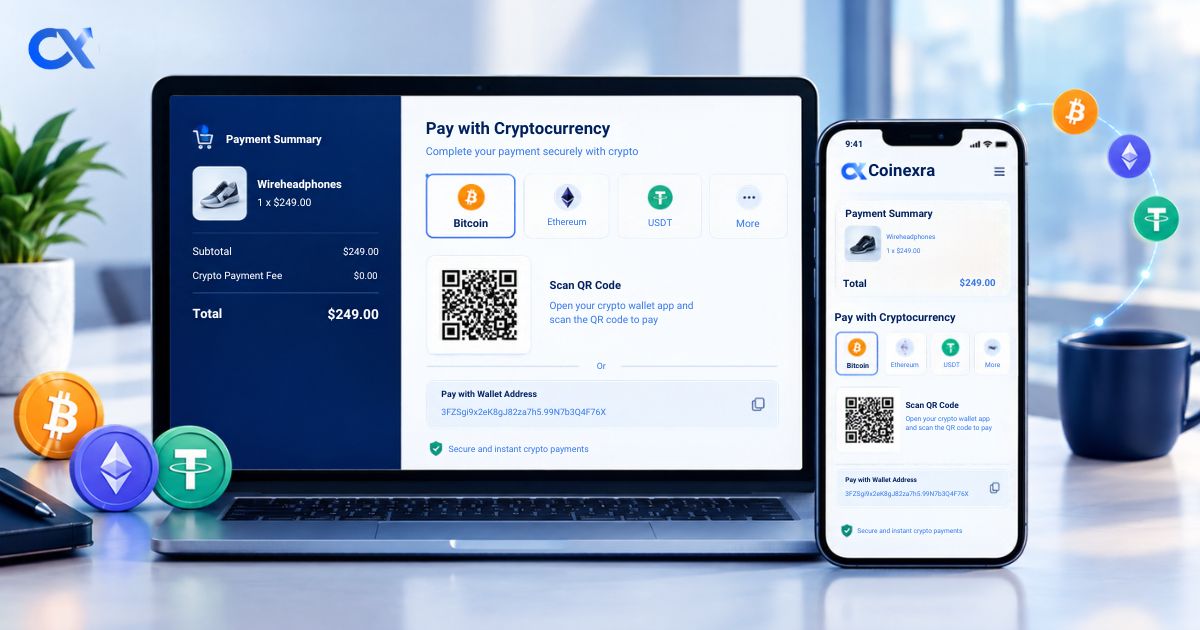

Businesses are increasingly accepting cryptocurrency as a payment method to serve global customers, reduce payment friction, and enable faster digital transactions. However, building a crypto payment gateway from scratch requires significant investment in blockchain infrastructure, security, payment processing, APIs, wallets, and compliance.
A white-label crypto payment gateway provides a faster alternative. Businesses can leverage pre-built payment infrastructure, customize the platform according to their brand, and launch their own crypto payment solution without developing every component from the ground up.
This guide explains how to build and launch a crypto payment gateway using white-label crypto payment gateway software, covering its core features, development process, technology stack, security requirements, and business benefits.
What Is a White Label Crypto Payment Gateway?
A white-label crypto payment gateway is a ready-made cryptocurrency payment processing solution that businesses can customize, brand, and deploy under their own identity.
Instead of spending months developing blockchain payment infrastructure, businesses can use an existing platform and configure elements such as:
- Brand name and logo
- User interface
- Supported cryptocurrencies
- Blockchain networks
- Transaction fees
- Merchant dashboard
- Payment APIs
- Settlement options
- Payment pages
- Admin controls
The underlying infrastructure is already developed, allowing businesses to focus on branding, customer acquisition, merchant onboarding, and business operations.
Why Use White Label Software to Build a Crypto Payment Gateway?
Developing a payment gateway completely from scratch can involve complex blockchain integrations, wallet infrastructure, transaction monitoring, security mechanisms, and API development.
White label software can reduce this complexity and accelerate deployment.
Faster Market Entry
Pre-built payment infrastructure can significantly reduce development time compared with creating the entire platform from the beginning.
Lower Development Costs
Businesses can avoid building every component independently, reducing the initial investment required for blockchain infrastructure and engineering.
Customizable Branding
A white label platform can be customized with your business name, logo, colors, domain, and user interface to create a branded payment experience.
Multi-Currency Support
Businesses can configure support for multiple cryptocurrencies and blockchain networks based on their target market.
Ready-Made Merchant Infrastructure
Features such as merchant dashboards, transaction management, payment APIs, reporting, and settlement tools can be incorporated into the platform.
Scalable Architecture
A properly engineered solution can be designed to accommodate increasing transaction volumes, merchants, cryptocurrencies, and blockchain networks.
How to Build a Crypto Payment Gateway Using White Label Software
Launching a white label crypto payment gateway involves more than simply applying your logo to existing software. The platform needs to be configured, integrated, secured, tested, and prepared for production.
1. Define Your Business Model
Start by determining how your payment gateway will operate.
Define the ideal customer personas in this case, the target merchants, supported geographies, Ideal digital assets supported, compatible blockchains, transaction fees, and settlement modes.
Consider:
- Target customers
- Supported countries
- Supported cryptocurrencies
- Transaction fee structure
- Merchant onboarding process
- Settlement currencies
- Custodial or non-custodial architecture
- API access
- Payment processing model
- Compliance requirements
For example, a gateway targeting international e-commerce merchants may prioritize stablecoins, multi-chain support, instant payment notifications, and automated settlement.
2. Select the White Label Solution
Selecting the most suitable White Label Crypto Payment Gateway Solution is the following step. This has to be done with utmost consideration towards functionalities such as secure key management, transparency in cost structure, and highly scalable infrastructure with reliable documentation.
Evaluate the solution for:
- Blockchain compatibility
- Cryptocurrency support
- API availability
- Wallet infrastructure
- Security architecture
- Merchant management
- Payment processing capabilities
- Scalability
- Customization options
- Administrative controls
- Integration capabilities
It is important to choose infrastructure that can support your long-term requirements rather than selecting a solution based solely on its initial price.
3. Customize the Platform
Once the white label software is selected, customize the platform to reflect your brand.
Customization is the essential step in white-labelling. A white-label crypto payment gateway is branded with essentials like name, logo, domain, colour palette, payment page, email notification, and transaction receipt. A fully branded crypto payment platform serves as a source of trust for end users.
- Typical customization includes:
- Logo and brand identity
- Domain
- Colors and interface
- Payment pages
- Merchant dashboard
- Email notifications
- Transaction receipts
- Customer-facing screens
- Fee configuration
The goal is to make the platform appear and function as a unified product rather than a generic third-party solution.
4. Integrate Blockchain Networks
A crypto payment gateway needs blockchain connectivity to process cryptocurrency transactions.
Multiple integrated chains can serve merchants to make use of both EVM- and non-EVM-compatible coins. This gives customers an enhanced degree of flexibility while supporting a wide range of digital assets, including comprehensive stablecoins like USDT and USDC, to initiate their transactions.
Depending on your business requirements, the gateway can support networks such as:
- Ethereum
- BNB Chain
- Polygon
- Solana
- Tron
- Bitcoin
- Avalanche
- Arbitrum
- Base
Multi-chain infrastructure allows merchants to accept payments across different blockchain ecosystems while giving customers more payment options.
5. Configure Crypto Wallet Infrastructure
Wallet infrastructure is another important component.
Configuring the secure crypto wallet infrastructure to generate addresses, monitor on-chain transactions, confirm transactions, and manage settlements with full control. Configuration also involves determining who gets to control the private keys for centralized and decentralized use cases.
Depending on the platform architecture, businesses may implement custodial or non-custodial payment processing.
Wallet functionality may include:
- Deposit addresses
- Payment address generation
- Transaction monitoring
- Balance tracking
- Fund transfers
- Wallet management
- Withdrawal processing
- Blockchain confirmations
For businesses handling customer funds, wallet security and key management require particular attention.
6. Integrate Crypto Payment APIs
Payment APIs allow merchants to connect their websites, applications, marketplaces, and other platforms to the gateway.
Integrating secure crypto payment APIs gives merchants a secure and efficient way to handle tasks such as payment invoice generation, address creation, and settlement initiation. They also provide additional benefits through webhooks for essential tasks such as order confirmation.
A well-designed API can support functions such as:
- Creating payment invoices
- Generating payment addresses
- Checking transaction status
- Processing payment confirmations
- Retrieving transaction information
- Managing refunds
- Receiving payment notifications
Webhooks can also notify merchants when a transaction reaches a required confirmation state.
7. Add Merchant Management
The merchant dashboard should provide businesses with visibility and control over their payment activity.
Adding a merchant management dashboard enables businesses to review transaction history, create relevant receipts through invoices, configure API keys, and connect webhooks to notify users about refunds, balance updates, and settled funds. A merchant dashboard also provides greater visibility into payments processed, revenue generated, and operational efficiency.
Important dashboard functions can include:
- Transaction history
- Payment status
- Payment invoices
- Settlement records
- Revenue reports
- API credentials
- Webhook configuration
- Refund management
- Wallet balances
- Payment analytics
An intuitive dashboard can significantly improve merchant adoption and daily usability.
8. Implement Security Measures
Security should be considered throughout the development process rather than added after deployment.
Crypto payment gateway security is layered through MFA, RBAC controls, encryption, API Authentication, rate limiting, whitelisted users, and highly secure key management. This allows forced liquidations, detailed audit logging, and protected merchant funds.
A crypto payment gateway may incorporate:
- Multi-factor authentication
- Role-based access control
- API authentication
- Encryption
- Secure key management
- Transaction monitoring
- Withdrawal controls
- Address whitelisting
- Rate limiting
- Fraud detection
- Audit logging
Smart contract and blockchain integrations should also be reviewed and tested before being used in production.
9. Configure Fees and Settlement
The platform should allow the operator to define how transactions are priced and settled based on business requirements.
Possible revenue mechanisms include:
- Percentage-based transaction fees
- Fixed transaction fees
- Merchant subscription plans
- API usage fees
- Withdrawal fees
- Currency conversion fees
Settlement can also be configured based on merchant preferences. Merchants may receive cryptocurrency or, where supported, convert assets into selected fiat currencies or stablecoins. Operators can also define settlement schedules, supported currencies, and minimum settlement thresholds for greater control over payment operations.
10. Test the Payment Gateway
Before launching, conduct comprehensive testing across the entire payment flow.
Testing should cover:
- Payment creation
- QR code payments
- Blockchain confirmations
- Failed transactions
- Duplicate transactions
- Refunds
- Withdrawals
- API requests
- Webhooks
- Wallet operations
- Merchant onboarding
- Admin functions
- Security controls
- High transaction volumes
Testing on appropriate blockchain test environments can help identify technical issues before production deployment.
11. Launch and Scale
After testing and compliance preparation, the gateway can be deployed for merchants and customers.
Post-launch activities should include:
- Infrastructure monitoring
- Security monitoring
- Performance optimization
- Blockchain integration maintenance
- Customer support
- Software updates
- Merchant onboarding
- Analytics and reporting
As transaction volume increases, the infrastructure can be scaled to support additional merchants, networks, currencies, and payment traffic.
Essential Features of a White Label Crypto Payment Gateway
A competitive white-label crypto payment gateway can include the following essential features:
Multi-Currency Support: Accept payments in multiple cryptocurrencies and stablecoins.
Multi-Chain Support: Process transactions across different blockchain networks.
Payment API: Connect merchant websites, applications, and platforms to the gateway.
Merchant Dashboard: Manage payments, transactions, invoices, and settlements.
Crypto Wallets: Generate and manage payment addresses and crypto balances.
Payment Invoices: Create crypto payment requests with the required payment details.
QR Code Payments: Simplify crypto payments through scannable QR codes.
Real-Time Notifications: Notify merchants about payment and transaction status.
Transaction Tracking: Monitor blockchain transactions and payment confirmations.
Automated Settlement: Streamline the settlement of funds to merchant accounts.
Admin Dashboard: Manage merchants, transactions, fees, currencies, and platform settings.
Analytics & Reports: Monitor payment activity, transaction volumes, revenue, and settlements.
Technology Stack for a Crypto Payment Gateway
Most secure crypto payment gateway technology stacks combine an auto-scalable front end, safest backend APIs, reliable chain connectivity in the case of DAPPs, compliant wallet architecture, and on-time transaction monitoring.
Businesses can be assured of legit revenue through frameworks operating on React, Node.js, PostgreSQL, Redis, Docker, and multi-chain RPC integration.
The technology stack depends on the architecture and business requirements. A typical solution may use:
Frontend: React.js, Next.js, HTML, CSS, JavaScript
Backend: Node.js, Java, Python, or Go
Database: PostgreSQL, MongoDB, Redis
Blockchain: Bitcoin, Ethereum, BNB Chain, Solana, Polygon, Tron, and other required networks
APIs: REST APIs, WebSocket APIs, blockchain RPC APIs
Infrastructure: AWS, Google Cloud, Docker, Kubernetes
Security: Encryption, MFA, access control, secure key management, monitoring, and audit logging
White Label vs Building From Scratch
The choice between white-label software and custom development depends on your business objectives.
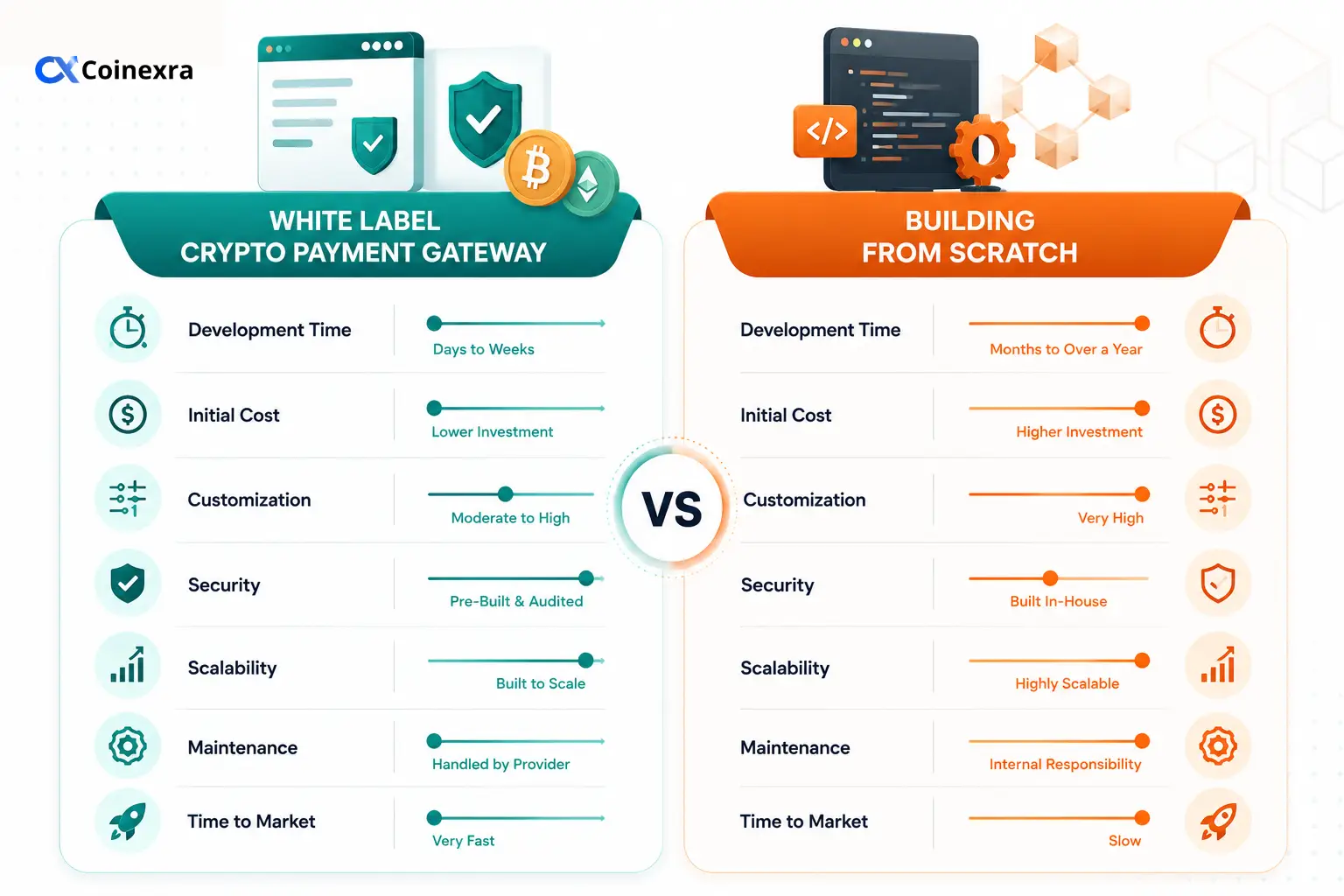
For businesses looking to enter the crypto payments market quickly, white label software can provide a practical starting point while still allowing substantial customization.
How Much Does It Cost to Build a Crypto Payment Gateway Using White Label Software?
The cost of building a crypto payment gateway using white-label software typically ranges from $5,000 to $30,000+, depending on the level of customization, supported blockchains, integrations, and business requirements.
The cost generally falls into these ranges:
Basic branded gateway: $5,000–$10,000
Customized payment gateway: $10,000–$20,000
Advanced multi-chain gateway: $20,000–$30,000+
The final cost depends on factors such as:
- Number of supported cryptocurrencies
- Blockchain integrations
- Wallet architecture
- Customization requirements
- API functionality
- Merchant features
- Security and compliance requirements
- Third-party integrations
- Deployment infrastructure
Businesses should also consider ongoing expenses for hosting, maintenance, security, compliance, and blockchain infrastructure, which are separate from the initial development cost.
Why Choose Coinexra for White Label Crypto Payment Gateway?
Coinexra provides white-label blockchain and fintech solutions designed to help businesses launch branded crypto payment products with reduced development complexity.
Our approach can include platform customization, blockchain integrations, merchant infrastructure, payment APIs, wallet functionality, security controls, and administrative features tailored to your business model.
Whether you are building a crypto payment service for e-commerce, SaaS, Web3, gaming, or cross-border businesses, a customized white label solution can help you establish your own branded payment infrastructure.
Launch Your Crypto Payment Gateway With Coinexra
Want to launch your own branded crypto payment gateway without building the entire infrastructure from scratch?
Talk to Coinexra to explore a white label crypto payment gateway solution tailored to your business requirements.