Real estate has traditionally been associated with large capital requirements, lengthy transactions, complex paperwork, and limited accessibility. But Real estate tokenization is changing the way businesses think about these limitations by introducing blockchain-based infrastructure into the ownership and investment process.
Instead of treating a property as a single investment that can only be accessed through typical ownership structures, tokenization can enable certain interests connected to the property to be represented digitally and divided into smaller units that can be owned.
This brings in new possibilities for capital formation, investor participation, record-keeping, distributions, and controlled transfers.
Although real estate tokenization has been mainstream for years, there are also misconceptions surrounding it.
Investors and property owners assume that buying a token means automatically owning the underlying building. Others believe tokenization guarantees instant liquidity, eliminates investment risk, or makes traditional property laws irrelevant. These assumptions can make an otherwise promising technology appear either more revolutionary or more complicated than it actually is.
But the reality is much more nuanced.
Real estate tokenization sits at the intersection of property, finance, regulation, technology, and investment infrastructure. Understanding how these elements mesh together is essential for anyone considering a real estate tokenization project.
What Is Real Estate Tokenization, Really?
Real estate tokenization is the process of using blockchain-based digital tokens to represent defined rights or interests connected to a real-world property or property-related investment.
Rights are where all of this makes a tie-in point.
A token does not mean the holder automatically owns a physical building. Depending on the structure, a token may represent an interest in a legal entity that owns the property, an economic interest, income rights, debt, equity, or another legally defined claim.
A typical real estate tokenization structure may involve:
- An underlying property or portfolio of properties
- A legal entity or ownership structure
- Defined investor rights
- Digital tokens representing those rights
- KYC and AML procedures
- Smart contracts and blockchain infrastructure
- Investor records and ownership management
- Distribution mechanisms
- Rules governing transfers or secondary trading
This view is vital, and this is also why real estate asset tokenization should not be viewed simply as "putting a property on the blockchain," because it is not that.
The blockchain is one layer of a much larger ecosystem.
In fact, current regulatory discussions around tokenization increasingly focus on the legal nature of the underlying rights, authoritative ownership records, custody, investor protection, and the relationship between legal documentation and digital infrastructure.
Why Is Tokenized Real Estate So Often Misunderstood?
Part of the confusion comes from blockchain's rise through cryptocurrencies; because both cryptocurrency and tokenized real estate use blockchain networks, it is easy to assume they operate the same way. They don’t.
Tokenized real estate is tied to an underlying real-world asset or a legal or economic interest associated with that asset.
Another source of confusion that exists with investors. Tokenization can make ownership interests easier to represent and transfer digitally, but it does not automatically change property law, securities law, investor rights, or market demand.
The American Bar Association's recent analysis of blockchain and property law highlights this distinction, noting that tokenization requires legal recognition and that traditional property recording and conveyancing rules can create significant limitations on direct digital transfers of real estate ownership.
With that foundation in place, several of the most common myths become much easier to understand. In this guide, we’ll explore the myths and debunk them.
Common Myths About Real Estate Tokenization
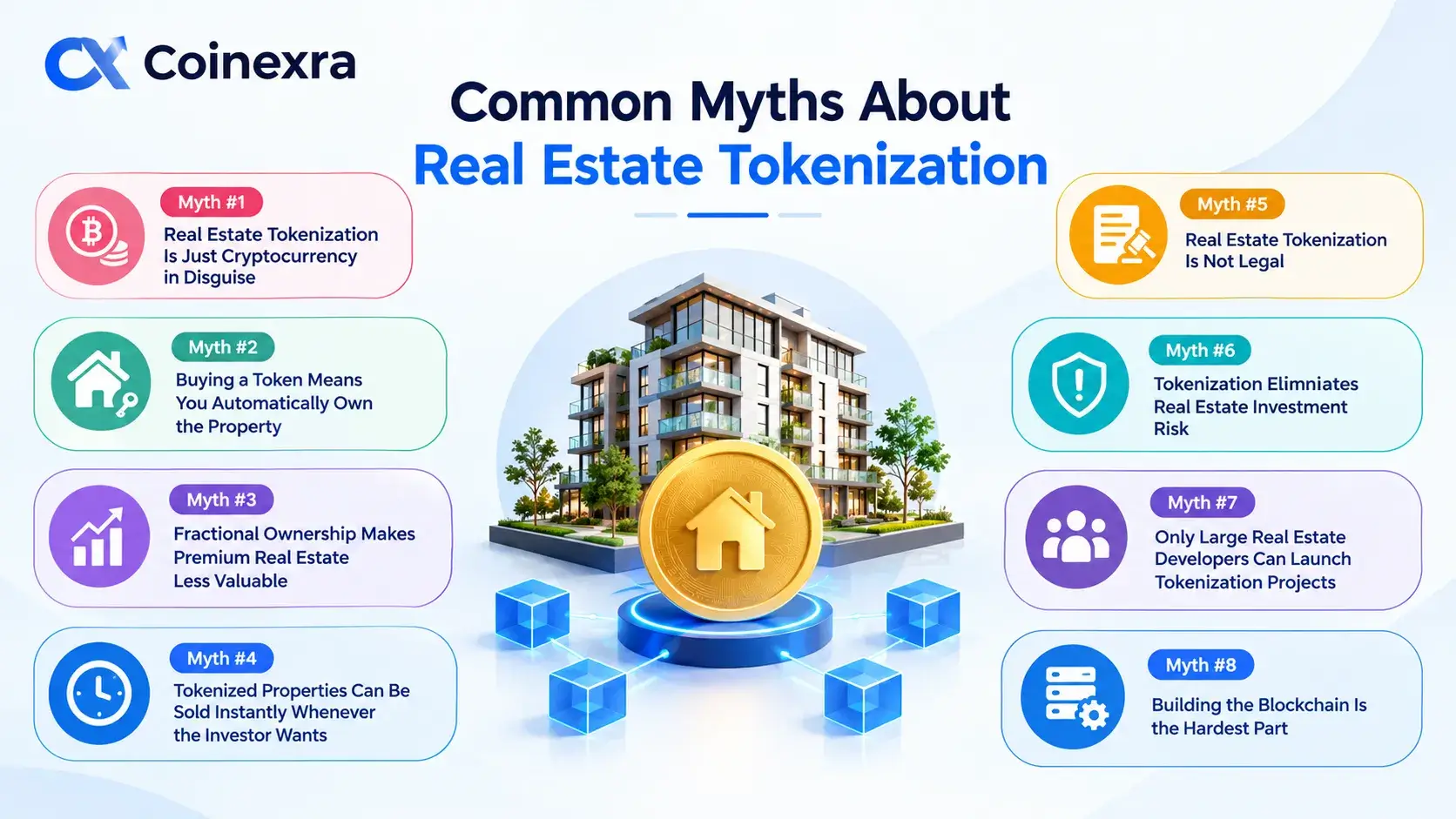
Myth #1: Real Estate Tokenization Is Just Cryptocurrency in Disguise
Truth: Real estate tokenization uses blockchain infrastructure to represent rights connected to real-world property, and not convert the property into crypto.
Essentially, both concepts use similar tech, but their economic foundations can be completely different.
With cryptocurrency, the digital asset itself is generally the asset being traded. With tokenized real estate, the token is connected to something outside the blockchain, such as a property, an ownership interest, rental income, debt, or another legally defined financial interest.
If a token represents an interest connected to an office building, for example, the value of that interest may be influenced by the building's location, occupancy, rental income, operating costs, financing, market conditions, and valuation, but these fundamentals are not altered.
Instead, it provides the infrastructure for:
- Recording digital interests
- Managing investor balances
- Automating predefined transactions
- Applying transfer restrictions
- Supporting distributions
- Maintaining transaction histories
- Connecting investors with digital ownership systems
A vital distinction that matters for businesses entering the space because choosing a blockchain network is only one part of the project. The more important questions often begin with the asset, the legal structure, the investor rights, and the regulatory framework.
Key takeaway: Tokenization does not turn real estate into cryptocurrency. It uses digital infrastructure to represent and tie it to real-world assets.
Myth #2: Buying a Token Means You Automatically Own the Property
Reality: A token does not automatically replace the legal title to real estate. What an investor owns depends on the legal and contractual structure behind the token.
An infamous misconception among investors and property owners that needs to be addressed.
Imagine a company owns an apartment building through a special purpose vehicle, or SPV. Instead of transferring the building directly to thousands of investors, the legal entity could issue interests that are represented digitally through tokens.
In that situation, an investor may hold an interest in the entity that owns the property rather than holding the property deed directly.
The rights attached to that interest could include:
- A share of rental income
- Economic participation in the property
- Equity rights
- Certain governance rights
- Redemption or exit rights
- Rights connected to the eventual sale of the asset
The exact arrangement is subjective. It depends purely on the project's legal structure and governing documents. A serious tokenization project must establish the legal relationship between the property, the ownership entity, and the token before investors are brought into the system, and this should be handled with utmost precision as it could lead to unfortunate consequences.
Myth #3: Fractional Ownership Makes Premium Real Estate Less Valuable
Debunked: Fractionalization changes the size and accessibility of investment interests, not the intrinsic value of the underlying property.
Fractional ownership is a concept backed by blockchain. Real estate investment structures have historically allowed multiple investors to participate in properties through partnerships, funds, trusts, companies, and other arrangements. And tokenizing them only adds a convenient layer to these structures.
Instead of one investor needing to acquire an entire property or a large ownership position, a suitable structure can potentially divide investment interests into smaller and investable units.
A win-win, as the underlying asset remains unchanged and makes participation accessible for all.
The important distinction is between fractionalization, tokenization, and liquidity. Fractional ownership platforms can potentially lower investment barriers, broaden participation, and make capital formation more flexible. However, fractionalization itself does not guarantee that investors will have an active market in which to sell their interests.
Key takeaway: Dividing an investment into smaller interests will never reduce the value of the underlying property but rather gives investors ground to participate in it.
Myth #4: Tokenized Properties Can Be Sold Instantly Whenever the Investor Wants
Truth: Tokenization can make certain transfers more efficient, but it cannot create liquidity without buyers, appropriate market infrastructure, and regulatory permission.
This is where one of the most common assumptions about tokenized real estate falls apart. Transferability is not liquidity and is a misconception amongst a lot of people.
A blockchain can record and execute a transfer quickly. That does not mean someone is automatically available to buy the token. For a tokenized property interest to have meaningful liquidity, several conditions may need to exist:
- There must be eligible buyers
- The transfer must be legally permitted
- The platform must support the transaction
- Investor eligibility rules may need to be checked
- Transfer restrictions may apply
- There needs to be sufficient market demand
- The asset needs a mechanism for determining price
A noteworthy point that focuses on why secondary market infrastructure is becoming an important part of real estate tokenization. Though Tokenization can improve the mechanics of transferring an investment interest, it is to be noted that only the market has to provide the demand.
Key takeaway: A token may be technically transferable without being economically liquid.
Myth #5: Real Estate Tokenization Is Not Legal
Reality: The legal treatment of a real estate tokenization project depends mainly on its structure, jurisdiction, investor rights, and applicable regulatory requirements.
There is no universal rule that says every form of real estate tokenization is either legal or illegal but rather should be framed as a question like “What is being tokenized, what rights does the investor receive, how is the offering structured, and which laws apply?”
Depending on the project, businesses may need to consider:
- Property and land laws
- Securities regulations
- Corporate and entity laws
- KYC requirements
- AML requirements
- Investor eligibility
- Offering restrictions
- Transfer restrictions
- Custody requirements
- Tax considerations
- Disclosure requirements
- Local registration rules
The regulatory picture is also evolving.
In the United States, ongoing SEC discussions around tokenization have focused heavily on issues such as legal classification, authoritative ownership records, custody, investor protection, transfer controls, and the relationship between traditional securities frameworks and blockchain-based infrastructure. At the same time, different jurisdictions are developing their own approaches.
Dubai's real estate tokenization initiative, for example, has been developed within a regulated framework involving the Dubai Land Department and other relevant authorities.
Being aware of the jurisdictional planning is essential. No two real estate tokenization project’s model is same or suit each other
Key takeaway: Real estate tokenization should be approached as a legal and regulatory project as much as a technology project.
Myth #6: Tokenization Eliminates Real Estate Investment Risk
Debunked: Tokenization can improve certain operational and transactional processes, but no, it does not eliminate the underlying risks of real estate investment.
Every investment carries its own risks, and no such risk-free investment exists. And essentially, a digital token does not make an underperforming property profitable.
If a property has weak occupancy, declining rental income, poor location fundamentals, high maintenance costs, or falling market demand, placing its investment interests on a blockchain does not remove those problems.
Tokenized real estate can still be exposed to several categories of risk.
Property Risks
- Vacancy
- Tenant defaults
- Maintenance costs
- Property damage
- Location-specific challenges
Market Risks
- Property value fluctuations
- Interest rate changes
- Changing demand
- Economic conditions
Technology Risks
- Smart contract vulnerabilities
- Cybersecurity issues
- Wallet security
- Infrastructure failures
Regulatory Risks
- Changing laws
- Transfer restrictions
- Investor eligibility requirements
- Jurisdictional uncertainty
Operational Risks
- Property management
- Distribution administration
- Valuation
- Reporting
- Governance
Though Tokenization improves transparency or automates certain processes, improvements and risk elimination are not one and the same and should not be confused with each other. For investors and businesses, this distinction is valuable because credible tokenization projects should communicate both the opportunities and the limitations.
Key takeaway: Tokenization changes the infrastructure surrounding an investment, not the fundamental risks of the underlying property.
Myth #7: Only Large Real Estate Developers Can Launch Tokenization Projects
Truth: A tokenization project's suitability depends more on the asset, legal structure, regulatory requirements, investor strategy, and infrastructure than on the size of the real estate company.
Large developers may have an advantage, including established assets, stronger balance sheets, larger investor networks, and internal resources, but tokenization is not a utopian tech limited to large property developers.
Depending on the applicable laws and structure, potential participants can include:
- Property developers
- Real estate investment firms
- Asset managers
- Hospitality businesses
- Commercial property owners
- Real estate funds
- Investment platforms
- Fintech companies
An important question is whether the project makes economic and regulatory sense.
Businesses should evaluate the following checklist:
- Is the underlying asset suitable for tokenization?
- Can the ownership structure support digital representation?
- Is there a clear investor proposition?
- Can compliance requirements be met?
- Is there sufficient investor demand?
- Can the business manage distributions and reporting?
- Is there a realistic path for investor exits?
A foolproof approach prevents businesses from treating tokenization as a technology trend that must be adopted simply because competitors are experimenting with it.
Key takeaway: The right starting point is project suitability, not company size.
Myth #8: Building the Blockchain Is the Hardest Part
Reality: Blockchain is only one component of a real estate tokenization ecosystem. Legal structuring, compliance, investor management, asset administration, and operational workflows are equally important and non-negotiable.
This is perhaps the biggest mistake businesses make when planning a tokenization platform.
They begin by asking, "Which blockchain should we use?" but rather, the focus should be “What needs to happen from the moment an asset is selected to the moment an investor receives and manages their interest?"
That process can involve several layers:
- Asset selection and due diligence
- Legal and ownership structuring
- Entity or SPV setup
- Investor rights definition
- Token model design
- Smart contract development
- KYC and AML integration
- Investor onboarding
- Token allocation
- Ownership and transaction records
- Distribution management
- Compliance controls
- Reporting and analytics
- Transfer management
- Secondary market integration where appropriate
It is to be noted that the blockchain network can provide the technical foundation, but it doesn’t independently solve the legal, financial, regulatory, and operational questions surrounding a real estate asset. The real estate tokenization project undertaken should be designed as projects should be designed as complete ecosystem rather than isolated token issuance applications.
Key takeaway: The blockchain is infrastructure. The real product is the complete system connecting assets, legal rights, investors, compliance, and operations.
Myth vs Reality: What Real Estate Tokenization Actually Changes
| Common Myth | Reality |
| Real estate tokenization is cryptocurrency | Blockchain is used to represent defined interests connected to real-world assets |
| Buying a token automatically means owning the property | The investor's rights depend on the legal structure |
| Fractionalization reduces property value | It changes how investment interests are divided and accessed |
| Tokenized properties are automatically liquid | Liquidity requires buyers, market infrastructure, and permitted transfers |
| Tokenization is not legal | Legal treatment depends on jurisdiction and project structure |
| Tokenization eliminates investment risk | Property, market, technology, regulatory, and operational risks remain |
| Only large developers can tokenize property | Project suitability matters more than company size |
| Blockchain is the whole solution | Legal, financial, compliance, operational, and technology layers must work together |
What Businesses Should Consider Before Starting a Real Estate Tokenization Project
If you are considering real estate tokenization, don’t fall prey to the temptation of the blockchain tech alone. Before selecting a blockchain or developing a platform, decision-makers should establish what the project is actually trying to achieve.
1. What rights will the token represent?
Is it equity, income participation, a beneficial interest, debt, or another contractual right?
2. Who legally owns the underlying property?
The ownership structure needs to be clearly established before designing the digital representation.
3. Which jurisdiction governs the project?
Property, securities, tax, and digital asset regulations can vary significantly between jurisdictions.
4. Who can invest?
The project may need rules governing investor eligibility, geographic restrictions, accreditation, or other requirements.
5. What compliance requirements apply?
KYC, AML, investor verification, transaction monitoring, and reporting may all form part of the platform.
6. How will investor ownership be recorded?
Businesses should determine how the digital record connects with authoritative legal and ownership records.
7. How will income or proceeds be distributed?
If the asset generates rental income or other returns, the platform should have a clearly defined distribution process.
8. What happens when an investor wants to exit?
An exit mechanism should be considered before the platform launches, not after investors begin asking to sell.
9. Will secondary transfers be permitted?
If transfers are allowed, the platform may need eligibility checks, transfer restrictions, market infrastructure, and compliance controls.
10. Can the infrastructure support multiple properties?
A platform designed for one property may not be sufficient for a business planning a portfolio of tokenized properties.
These questions shift the discussion from the cliche, "How do we create tokens?" to the more viable question, "How do we create a legally structured, compliant, scalable investment ecosystem around real estate assets?"
What Should Businesses Look for in a Real Estate Tokenization Company?
A very important perspective lies here. Choosing a real estate tokenization company should involve more than comparing development costs or blockchain networks. The technology partner should be capable of understanding that tokenization requires several interconnected components.
Compliance-oriented Architecture
The Tokenization platform should be capable of supporting the compliance workflows appropriate to the project's jurisdiction and investment model.
Flexible Tokenization Models
Different properties may require different structures, so the technology should not force every project into one rigid token model.
Fractional Ownership Functionality
For suitable projects, the infrastructure should support the creation and management of smaller investment interests.
Investor Management
Investor onboarding, verification, account management, ownership tracking, and transaction history should be integrated into the broader platform.
Smart Contract Infrastructure
Smart contracts can automate predefined rules around token issuance, transfers, distributions, and other functions where appropriate.
Asset and Distribution Management
A tokenization platform should connect digital ownership with the operational management of investor interests and relevant distributions.
Administrative Controls
Businesses need appropriate controls for managing properties, investors, transactions, permissions, compliance workflows, and reporting.
Scalability
A serious platform should be capable of supporting the business beyond its first tokenized property.
For businesses looking to establish this infrastructure, Coinexra provides a foundation for developing a branded real estate tokenization ecosystem through its White Label Real Estate Tokenization Platform.
A perfectly adaptable infrastructure that sits on the crevices of the project's asset model, investor requirements, and operational objectives without treating tokenization as a one-size-fits-all product but rather a tailored platform built to achieve your business goals.
The Future of Tokenized Real Estate Is Bigger Than Putting Property on a Blockchain
The long term opportunity in tokenized real estate is unlikely to come from simply replacing paperwork with tokens. The more interesting development is the creation of connected digital infrastructure around real-world assets.
That can include:
- Digital investor onboarding
- Programmable ownership structures
- Automated distributions
- Transparent transaction records
- Controlled secondary markets
- Compliance-enabled transfers
- Portfolio-level asset management
- Institutional investment infrastructure
- Integration with broader real-world asset ecosystems
It is to be noted that the direction of the industry is already moving toward more sophisticated infrastructure rather than typical token issuance alone. Current regulatory discussions are increasingly concerned with legal enforceability, authoritative records, custody, transfer controls, and investor protection.
Dubai's progression from a pilot phase toward controlled secondary-market resale is another example of how the industry is testing the infrastructure required to make tokenized property markets function in practice.
It has shifted from a question of whether a property can be tokenized to whether the property is an eligible choice and a compliant, investable, manageable, and scalable digital ecosystem.
Frequently Asked Questions
What is real estate tokenization?
Real estate tokenization is the process of representing defined rights or interests connected to real estate through blockchain-based digital tokens. Depending on the structure, the token may represent equity, income rights, an interest in an entity holding property, debt, or another legally defined interest.
How does real estate asset tokenization work?
A typical project begins with the underlying property and its legal ownership structure. The business then defines investor rights, creates the appropriate token model, integrates compliance and investor onboarding, and uses blockchain infrastructure to issue and manage the digital representation of those interests.
Does buying a token mean I directly own the property?
Not necessarily. The token may represent an interest in an entity that owns the property or another legally defined economic or contractual right. The exact rights depend on the project's legal structure and documentation.
How do fractional ownership platforms work?
Fractional ownership platforms allow investment interests to be divided into smaller portions, enabling multiple investors to participate in an asset or investment structure. Tokenization can provide digital infrastructure for representing and managing those interests.
Are real estate tokenization projects legal?
The answer depends on the project's structure and jurisdiction. Businesses may need to address property law, securities regulations, KYC, AML, investor eligibility, tax, disclosure, and transfer requirements before launching.
Are tokenized properties liquid?
Not automatically. Tokenization can make certain interests easier to transfer, but liquidity depends on buyer demand, market infrastructure, applicable transfer rules, and regulatory conditions.
What does a real estate tokenization company do?
A real estate tokenization company can provide the technology infrastructure required to represent, issue, manage, transfer, and administer digital interests connected to real estate assets. Depending on the provider, this may include smart contracts, investor management, compliance integrations, asset management, and distribution functionality.
What should businesses consider before tokenizing a property?
Businesses should evaluate the property's suitability, legal ownership structure, investor rights, jurisdiction, compliance requirements, distribution model, transfer mechanisms, investor demand, and long-term technology requirements before beginning development.
Conclusion: Real Estate Tokenization Is More Than a Blockchain Upgrade
The biggest misconception about real estate tokenization is that the technology itself is the transformation.
The real transformation comes from bringing together real-world assets, legal structures, investor rights, compliance systems, digital ownership infrastructure, and blockchain technology into one functioning ecosystem.
Tokenization can create new possibilities for fractional participation, digital investor management, automated processes, transparent records, and controlled transfers. These aren’t a compromise of property law, regulation, market demand, and the realities of managing serious real estate.
Coinexra’s White Label Tokenization Platform is built for businesses looking for a scalable and robust ecosystem that handles complex blockchain infrastructure and also supports international compliance and security standards like none. A market-ready, battle-tested solution that eliminates the usual operational challenges that come from building from scratch, with no compromise on user experience.